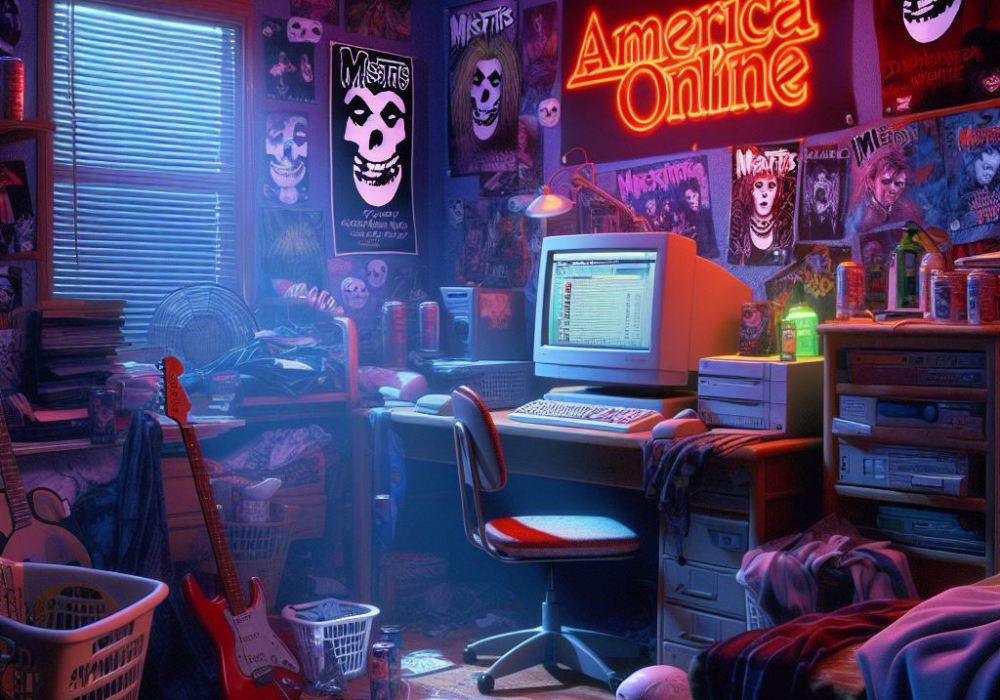
“Possession of the mind is a terrible thing; it’s a transformation with an urge to kill.”
Her name was Jessica and she went to my high school. She was my first real girlfriend, gained at a time when I had lost hope in ever getting a real girlfriend. One I really liked. One I was genuinely attracted to. One who made my heart flutter with anticipation– like every day dream you’ve ever had during that long static age when you’re aware of girls, their big eyes and emerging bustlines, ones confident in testing the elasticity of all formerly loose fitting tank-tops; all around you but a world a way and you’re still stuck on the very first screen; the master sword collecting dust; Gannon raping Hyrule with impunity.
I was at a point of rational acceptance bordering on the contemplation of a secular monastic lifestyle: what could I accomplish if not in pursuit of a girlfriend? A question Dan wasn’t willing to entertain. He became enamored with Big Sandwich Girl– a pretty, freckled, Irish blonde with large breasts that she had not yet grown accustomed to having, with significant tapering used as a precautionary measure under her white button down blouse, like she knew she had the world’s greatest secret and she was sneaking it home every night with lips sealed. She presumably had no lunch period during her hectic, ambitious, Ivy League-track schedule and was only in our third-period Theology class as a necessity– no honors section was offered– where she would eat her lunch and she always had a very large sandwich.
It was her very large sandwich that made her seem attainable. This was a girl who had not yet developed a sense of what other girls intuitively began to know as if on cue; a gameplay event triggered by puberty; a short cutscene transformation where all girls learn how to attract popular boys, an exclusive club to which Dan did not belong. However, Big Sandwich Girl’s large sandwiches seemed to imply a disconnect between what she looked like and how she imagined herself: a pretty girl would never eat so much so shamelessly, something Dan had considered maladaptive behavior. Pretty girls are meant to act daintily, this was a rule– rules that become mandatory almost overnight; over the course of a single summer, where girls end up less interested in reading and more interested in make-up; rules that were presumably misunderstood by an awkward cheerleader with twelve inches of whole wheat in front of her.
Without a more developed sense of social acuity, Big Sandwich Girl, with her freckles and her tapered breasts, exuded a fleeting sense of purity. An innocence that is all but lost by a girl’s Senior year of high school– by her sneaking cigarettes and giving blow jobs; by autodetecting the proper social code for fitting in and unconsciously shaping herself into that mold. Big Sandwich Girl still seemed to possess the naive beauty of a Disney Princess: adorably unaware of her own preciousness. She didn’t yet know the rules to follow.
This was his opening. Dan found something he assumed no one else could see. Something hiding in plain site, only under a multitude of cotton layers and several thick shoulder straps. A faint silhouette of what could be softball-sized under more idyllic conditions. Things that only become visible given time, thought, and close inspection– all of which Dan committed his class time to, roleplaying Indiana Jones and the Temple of Big Tits, and he was ready to fight through fire and flame to rescue the maiden and claim his treasure. He had one shot to get it right.
Dan had a lot to think about.
***
Purity can only exist in a tiny window before the rules are written. Before clawing at the howling monolith in the barren desert. Before the Platonic form: the roadmap promising harsh penalty to those who deviate. Before Jesus Christ– the name so bright and so sharp that the sign just blows up because the name is so powerful. Before order there can only be mayhem. Trial and error; chaotic attempts– and only in such madness is there authenticity.
Venom thrived under these conditions, as a heavy metal pre-Socratic in the days before Master of Puppets (1986) served as a 12” vinyl warning to any band who dared compete: thrash riffs at a manic pace or else. Master of Puppets defined heavy metal as technical mastery; Venom defined metal as a tough-as-nails attitude. Lead singer Chronos didn’t actually sing: he barked and snarled, about sex and the devil. They took the rough edges of 1970’s punk rock met with a few KISS inspired sex songs and Black Sabbath-like odes to the Dark Lord– and while the feverish reception to Sabbath’s more devilish music scared the devout Christians into using giant crosses as set pieces while writing lyrics that stated plainly, “God is the only way to love,” Venom felt no such trepidation for being considered Satanic.
Find a better 80’s tinged Friday night than being fifteen and spinning side one of At War with Satan (1984) on repeat while playing Atari under the twilit glow of the television– pizza crusts and Pepsi cans as the night’s only collateral damage. Side one on repeat because there was no reason to flip At War with Satan– side one being entirely taken up by Venom’s epic, twenty-minute long title track chronicling Hell’s overthrow of Heaven– At War with Satan presents as dark, forgotten history. The final book of the Bible that had been lost; hidden; obscured by time. A song carrying realistic concern that, if played backwards, could open The Gate (1987) to Hell and summon demons. In 1984, there was no eighth grade boy on the planet who wouldn’t have liked At War with Satan, and yet, for reasons inexplicable, Venom’s mainstream, genre defining, rule writing popularity was quashed by the gravitational pull of what was to come next– the then unwritten, aptly titled Master of Puppets.
Sometimes the future will have a gravity that can be felt in present.
Miyamoto’s combination of stompy, jumpy action and exploratory adventure was its own master leading countless puppets, setting a precedent for home gaming that would dominate the decade. Super Mario Bros. had a tremendous number of imitators who’d put their own spin on its core mechanics, to the extent that the formula became understood as the essential components of what made a video game– Super Mario Bros. had single-handedly redefined video gaming in its own overalled image.
Before these rules were written– before there was a roadmap to follow– attempts at creating games in the adventure genre, an action game with exploratory elements, were constructed with complexity by stoned programmers who thought the game’s goal, and the mechanics required to achieve that goal, should be left for the player to discover. This was taken for granted in the NES era where everything needed to play the game was contained on screen. Looking at a lengthy instruction manual was for your boomer dad, Nintendo games were pick up-and-play.
The few ambitious Atari titles that attempted to construct lush adventures through dots and blips made the player fight for comprehension with the central question being: what is going on? It was the player’s job to construct meaning; the construction of meaning became the goal of the game. The gameplay was in attempting to understand the game. Like Venom had failed to become a force powerful enough to embody the genre’s rule writing, monolithic presence, complex esoteric adventure games like Raiders of the Lost Ark (1982) and E.T. the Extra-Terrestrial (1982), although ambitious for their time, were resoundingly hated for such ambitions.
The magic of a moment like breaking through the top of the screen in only the second level of Super Mario Bros. gave the player a surreal feeling of being a participant in an unfolding, predestined world while actively creating that world in real time– which is something that can only happen once and ends the moment the player reads: “Welcome to Warp Zone!” Although fleeting, when experienced in its proper context– not unlike the shock of watching The Empire Strikes Back (1980) on opening night– this moment stands as the single greatest in video game history. There is nothing else like it because there can’t be anything else like it. It’s a trick that works exactly once before the audience grows wise to it.
The utility of this moment was a mechanic delivered with perfection: the NES player was taught to think outside the box. Miyamoto knew that once a player saw the top of the screen accessible, their natural curiosity would get the better of them and that curiosity was rewarded with the ability to skip levels. Teaching a player game mechanics organically became common with NES games like Metroid (1987)– a game that was consciously made to be the anti-Super Mario Bros..
Metroid’s development team knew that an experienced video game player would instinctively began a side-scrolling game by running to the right, but when the first-time player begins Metroid, running to the right leads to a dead end. This dead end forces the player to return to the starting point and try their only other option: moving to the left, and only then are they able to obtain an item necessary for the game’s progression. With this, the player subconsciously internalize the lesson Metroid is imparting on them: to make progress they will be tasked with solving obtuse problems that require unique solutions; the player will need to think on their feet, maybe for the first time in a video game. Anything but the use of sharp wit when adapting to newly encountered dead ends will halt the player’s progress– Metroid did not present a single braindead pathway to the end of the game; Metroid was non-linear; Metroid made you think.
While Super Mario Bros. was bright and inviting, Metroid was dark and ominous. While Mario’s world felt teeming with life, Metroid’s atmosphere was lonely. Metroid was for the introvert; the kid who wanted to be left alone; the kid who had trouble making friends; the kid who’d cry on the first day of summer camp. The kid who understood the world as unfriendly and uninviting; who maybe realized that life only gets a little bit worse with each passing year. The kid who wanted to be underwater and far away; who wanted to stay hidden in his bedroom-like cocoon. Metroid embodied the fantasy of floating through space. Away; alone in the dark. Away, under the twilit glow of the television.
***
Steve took me aside and told me, in as stern a tone he could muster, that we needed talk– specifically to talk privately. He spoke with a calculated sincerity tempered with a deliberate urgency. His posturing carried authoritative overtones, poised to give pseudo-fatherly advice from a faux-big brother; Songs of Experience (1794) sung by an idiot. There was a sense of superiority peppered into his inflection, and I knew this superiority was squarely earned: Steve was the first of us to have a girlfriend.
There was no good reason for this; no lesson to be learned or technique to be gleaned. Steve was in the right place at the right time. There was a blue-light special on hand-jobs and Steve was first in line. He caught a shooting star on his camcorder and ended up on the evening news with a goofy smile. Accidentally dropped a bomb on the right rock and tripped over the master sword. No matter how much you believe that sexual success depends on hacking the social algorithm with a keen understanding of interpersonal dynamics, stupid motherfuckers still win the lottery.
For a sixteen year old, Sharon was winning the lottery. A short, fair-skinned redhead with large breasts and a spunky attitude, Sharon went to the local all-girl Catholic high school. A place where girls had trouble meeting boys. A veritable girlfriend factory, that manufactured local girls ready to be your friend; new-in-box; plug-and-play– a potential girlfriend goldmine… something can only be understood in retrospect, on those long sleepless nights; clawing skin for every inept decision made.
Colleen was one of those inept decisions. Sick of being ditched on weekends, Sharon’s best friend wanted a boyfriend. Colleen called me and introduced herself. She told me that we had things in common: we were the same age and both attended high school. We knew the same people. We met on a group trip to the mall. We hit it off– she wanted a boy to spend her Friday nights with and I wanted a girl to touch. She wasn’t pretty.
Colleen was my first girlfriend insofar as the term Pre-Socratic is a necessity; an aging single woman rolling back body count mileage like she’s Ferris Bueller with a brilliant idea; a space where something can exist but not count. Colleen existed but she didn’t count– she is not my canonical first girlfriend. We kissed and watched The Real World (1992). I felt her up and mentally cataloged the shape and feel of her breasts: middling B cups with nickel sized nipples. Her breasts were slightly wider than they protruded, like hanging pectorals.
I liked these experiences, but I didn’t love them. It wasn’t sexy like it should be; she didn’t look like I wanted her to look. I mentally cataloged these experiences to use as masturbation material for when I got home. These experiences were no different than my meager collection of Playboy magazines; my VHS tapes with nude scenes from late night HBO caught like shooting stars. A new medium with the same message: it’s okay to masturbate.
MTV had been in the process of quietly redefining what made them interesting. They began minimizing music content in favor of more traditional television programming. Until that point MTV had been different from everything else on television. Unlike everything else on television, MTV had followed a format closer to a radio station; music videos were played in blocks and on rotation. These videos did not typically attempt to form a cohesive narrative– they were often a variety of scenes clipped together. Music video production was often shoddy. Footage was not always fit for broadcast (either accidentally or by design). MTV was television that didn’t need to be watched.
The MTV format revolutionized how teenagers thought about music. While KISS prioritized image over sonics, the ragged look of the average 70’s musician was something between an afterthought and incidental. The actual music– the reality of being a musician– was of prime importance, which was initially how MTV approached its programming: following the industry with pragmatism. MTV was your cable channel guide to rock. Boring VJs spoke with academic inflection, covering news and a smattering of trivia about the old guard of aesthetically unfit rock musicians, between playing blocks of boring, aesthetically unfit rock videos. This format did not work. It was only when MTV found a new guard of rock star to promote, equal part showman, model, and musician, that they became kingmaker to the industry and a cultural force.
The very first MTV stars wrote the rules of rock and created tropes that became so institutionalized that MTV themselves began to parody them. By the end of the decade they had introduced Pauly Shore to their personality rotation. Shore was a stand-up comedian whose schtick was that of a hyper-realized, west coast, rockstar wannabe. Shore, himself, wasn’t a musician but the image trappings of the rock star became so ingrained that they existed at the forefront of the average person’s understanding of music: if you wanted to be a rock star, you started by looking like a rockstar. You were better off learning the aesthetics and posturing than you were mastering an instrument. One needn’t play music for one to be a rockstar; the fantasy replaced reality.
MTV culture not only wrote the rules for the aspiring musician, but created a mold for how teenagers presented themselves: MTV wrote the rules for being cool. Every socially successful teenager looked to become their own version of a rockstar– complete with a rock star style’d, deliberately ratty and shredded wardrobe, an intentionally messy hair cut, piercings, tattoos, and a badass car. MTV half-fulfilled Anton LaVey’s promise of “hyper-individualism as a replacement for religion” made at the dawn of the media age but with fascistic aplomb: you will be your own God but only by following our rules.
When Steve got around to talking to me, finally, in private, he used a haggard hush to prompt my understanding that this conversation was serious. This wouldn’t be about the forthcoming Metallica album, Load (1996), and our speculation of its sound and direction. A never ending conversation fueled by having already heard two entries from it on a bootleg tape from someone who had recorded the band’s Donington concert with what sounded like a tape recorder, in a duffel bag, wrapped in ten-thousand t-shirts. We still spent the summer listening to it at max volume on my blown-out Casio tape deck, riding bikes to Movieland and renting Super Street Fighter 2 (1994) while waiting for nude pictures of Playboy Playmates to download from AOL chat rooms as we ate our Taco Bell items ordered from the 49¢/79¢/99¢ menu– perfect for a high school kid with only a handful of pocket change.
For Christmas the year prior I got an IBM PC compatible personal computer, complete with Windows 3.2 and a CD-ROM drive. While I had grown up with my beloved Commodore 64, it was more of an esoteric gaming console than a real computer: games on floppy disks unlocked through bizarre command prompts punched into a lifeless blue screen. A process that lent the meager games an air of sophistication; that they were in a class beyond the cartridges sold for the more pedestrian Nintendo Entertainment System. This wasn’t entertainment. This was serious. Computer games weren’t for kids.
The CD-ROM was fascinating. I always wanted the set of World Book encyclopedias that Steve had on a dusty basement bookshelf– now my computer had every volume on a single disc. I would find articles that interested me and print them out. My new computer came with a racing game where a futuristic host in video cut-scenes berated me for my racing inadequacies. I would play the racing game. My new computer came with productivity software. I enjoyed knowing I had productivity software.
But for all of its technological terror, the computer failed to keep my attention: it was a static experience; a closed system. Maybe there was a time when the mere interactivity between man and machine would have been enough; maybe I would have fingered the secretive inner workings of the C-drive like a surrogate girlfriend. Navigating the black screen of DOS like I was floating through space. Reading The Annotated C++ Reference Manual (1990) like its Nabokov. Writing code like poetry. Maybe this would have shaped the person I’d have become but the Internet loomed, its future presence with the gravitational pull of an artificial moon.
I wanted to be David Lightman in WarGames (1983)– my first glimpse of connectivity. Where a computer could function beyond the lifeless exchange of data inputs: it could be used to explore the outside world; to create causes that had effects; to interact with real people. People whom you’d never have met any other way, in any other circumstance, other than with screens and keyboards. Your phone line indefinitely occupied; your reach potentially infinite. Shall we play a game?
More importantly than any other feature, my new computer came with a 14.4 baud dial-up modem and a free trial of online service Prodigy… and while Prodigy soon became America Online, I’ll never forget the feeling of my first night in a chatroom. It wasn’t about what was being said; what was being said was never terribly interesting, ever, in any chatroom…this was about a shared fascination with a newfound communication utility. A fascination with our shared present moment, a new kind of atomized togetherness, all through screens and keyboards, as if we knew that what we saw unfolding was so bright and so sharp that it was destine to blow up because the medium was so powerful. There was utility to the Internet, we knew it from the moment we logged on, but we didn’t know yet how to harness it. The canvas stood before us pristine.
It was through these chatrooms that a teenager could explore the night time world without invasive eyes; the hidden adult world; the degenerate and depraved adult world… into the lawlessness of a new frontier; the wild west; in barren fields on the Arizona plains… Taking what we wanted along the way. Shannen Doherty’s issue of Playboy collecting dust under my bed as nude celebrities drifted to my screen at the speed of shifting continents. Illegal downloads and password swapping– nothing seemed impossible, nothing seemed immoral. Nothing seemed quite real. This was a new space, a cyber space, a plane of existence between reality and fantasy, so new that we couldn’t fully understand it; we couldn’t fully see it. An existence you were able to define for yourself; an identity you could build– where you could feel powerful, even if the girls at school didn’t think so; even if your parents didn’t respect you; even if you were bully fodder for the guys getting blow jobs on Friday nights, you still got yourself a hacked up version of Doom II (1994) for free and that felt like it mattered more. That felt more significant. That felt like true power; limitless power; omnipotent power; inhuman reproduction, we’re here for what we want!
Between poorly planned high school social circles that seemed cemented in place and overheard chatter of house parties and easy hook-ups, a teenager guided by a strong sense of sexual frustration will unconsciously devote an unknowable percentage of cognitive power humming in the background– crunching data like a Seti screen saver– to the pursuit of sexual objectification, and when real life doesn’t present an obvious next move, you start bombing the mountainside and pushing over tombstones like you’re Link with an expired Nintendo Power subscription. Joshua tirelessly entering random launch codes at NORAD desperately hoping to just get one right. Staring at a bastard dead end in Metroid; your sharp with your only weapon. Trial and error; clumsy attempts– before order there is only mayhem.
The invisible hand pushing toward late night sessions in Local Romance chatrooms, where the determined teenage boy had endless chances to message girls, desperately hoping to just get one right. Real girls who would describe themselves in tantalizing ways, before pictures were common– their descriptions falling somewhere between reality and fantasy… Real girls who would respond to your charm and bravado, even if you were making it up as you went along. If you want to be a rock star, you start by acting like a rock star– the Internet could allow the fantasy to replace reality entirely. A little seventeen-year-old egomaniac, even if only from his bedroom, but with every Instant Message, every time you hit on the right words in the right order, you got one step closer to unlocking nukes and launching missiles…and even if you were told to be on the lookout for pink sneakers one Saturday afternoon at the mall, and the only pair you saw sped past you like a girl with blast processing– either embarrassed or disappointed, you’ll never know which– off into the ether, you learned a valuable lesson that day: you almost had an real life first date, with a real girl, and you did it using screens and keyboards.
You did it using the Internet.
You were one step closer to the master sword. You couldn’t unsee it.
***
Doom (1993) became emblematic of a bleeding edge that only you and a few of your friends were tapped into; day one adopters; absolute lunatics, running top speed, in every direction with Big Fucking Gun in hand, into the unknown. Into poorly lit corridors with flickering lights, past non-orthogonal walls, with a glass cuttingly smooth frame rate and three fully realized dimensions. If virtual reality was a Hollywood promise made to impressionable kids by the prior year’s otherwise boring Lawnmower Man (1992), Doom fulfilled that promise with vicious immediacy.
Before Mortal Kombat (1992) hijacked what it meant to be a video game from Mario’s white gloved grip and redefined it as excessive violence, Sega had already been taking shots at Nintendo in ad campaigns highlighting Sonic The Hedgehog’s (1991) speed and attitude– Super Mario World (1991) crept along at a lazy river’s pace by comparison.
The Nintendo Entertainment System had a tremendous end to their introductory decade. Their brilliant, genre defining, self-published titles like coalesced with excellent third party enteries and managed to solidify video games as an inherent part of the cultural landscape– there would be no video game crash, as Atari had unwittingly facilitated in 1983. Video games were not a fad. Video games had become absorbed into the pantheon of mass media. Even if the “Nintendo Seal of Approval,” Nintendo’s theoretical method of quality control– devised to avoid the glut of poorly made, embarrassing 2600 cash-in titles– meant increasingly little in the face of shitty video games that made kids angry, Nintendo had enough quality titles at the forefront of public consciousness to maintain their positive image.
The next generation of game console expanded the definition of what it meant to be a video game while redefining expectations. Conceptually, a next generation of game console was a new idea– one that was met with skepticism from parents still reeling from the big money spent on beefing up their kid’s NES library, half of which were already dead on the shelf. This felt like forced obsolescence, a scam to produce screaming kids demanding new things, whatever the new thing was. Video game developers working to usher in a post-Nintendo Entertainment System era knew they had to deliver an excellent product which impressed with immediacy. Something that created urgency. A product that needed only a single screen shot to convert a skeptic into an enthusiast– something that could only be accomplished with great graphics.
Standing amidst the marketing hurricane that was the early 90’s sixteen bit console war, a kid would come to define a great game to mean great graphics– to the extent that it became a Freddy Kruegar joke in his kid-friendly, absolutely terrible Freddy’s Dead: The Final Nightmare (1991)– great graphics meant a great game… even when it didn’t. Even when you knew you had a stinking, unplayable, piece of garbage, it still meant something for it to have impressive graphics. Compared to the Sega Genesis and the Super Nintendo, the Nintendo Entertainment System did not have great graphics, and to your parents’ chagrin, it needed to be put away; it was a baby’s toy.
Nintendo’s competitors came up with two points of differentiation: attitude and violence. If Nintendo wanted to make a darn good game that the whole family could play, the only way to gain foothold in the market, and attract the attention of emerging adolescents, was to do the opposite. Like the Nintendo Entertainment System, a console designed to replicate the early generation of arcade games with accuracy, the initial concept for the Sega Genesis was to replicate newer, more advanced arcade games, a feat the aging NES hardware was too underpowered to deliver gracefully.
While the Nintendo brand became synonymous with the entire concept of home video gaming, so much that both kids and parents would often refer to playing video games with the simple, clunky phrase “playing Nintendo,” Sega had been quietly dominating the arcade scene with their “Super Scaler” games like Out Run (1986) and After Burner (1987). These games were like nothing seen before in video game play; certainly nothing playing Nintendo could compete with– especially if you were lucky enough to find a deluxe, sit-down cabinet with motion simulation, and even if you were so lucky, it was the Super Scaler technology that made the games come to life: your Ferrari Testarosa screaming down the highway with trees and road signs flying through the screen at ninety miles-per-hour. Nothing before was that fast. Nothing was that immersive. Nothing had such great graphics. But even if Sega won the fight for quarters in shopping mall arcades, their first attempt at home console competition fell flat with the Sega Master System. Even though the Master System ran like a more impressive NES, with better visuals and more colors, Mario had an iron clad grip on the industry, and kids weren’t going to give up playing Nintendo so easily.
Sega needed new hardware that could do what Nintendo couldn’t. Sega needed hardware to replicate the arcade experience– if not accurately at least adequately; spiritually; to a degree to which a passerby might say: “hey, that looks similar.” In 1989, Sega released the Genesis. The Genesis was able to replicate side scrollers like Golden Axe (1989) and Ghouls n’ Ghosts (1989) to near arcade perfection compared to their more primitive 8-bit renderings, and at release, replicate their Super Scaler arcade games well enough to look impressive in gaming magazine screen shots.
However, arcade replication was not enough for manufacturer Sega to truly compete with Nintendo… until they came up with their own cartoon mascot, Sonic the Hedgehog, an anthropomorphized animal with attitude, whose cool sneakers and scolding, title-screen finger wag made Mario seem sheepish by comparison. Soon there were dozens of cartoon animal mascots littering the home console scene. Mario’s domination of the pop-culture landscape, which had been on par with Hulk Hogan and Mr. T., began to seem as distant and as dated.
But when Doom caught on the whole “sixteen bit war” seemed quaint by comparison. Doom legitimized having a computer– the computer as inarguably superior technology; the computer as limitless possibility; the computer as infinite reach. Doom outclassed Nintendo and Sega in orders of magnitude, and it was through screens and keyboards. Doom was the perfect game at the perfect time; the genre defining monolith buried below the surface of the moon. Doom changed everything and there was no going back. Doom was relentless immersion.
Doom relied on both programmer John Carmack’s graphics engine, which made the game’s signature lighting and geometry possible, and game designer John Romero’s expert direction. Romero wanted Doom to be more than just run-and-gun annihilation. Like Miyamoto wanted Super Mario Bros. to be more than a stompy, jumpy action game, Romero had wanted Doom to have an exploratory component. Romero wanted Doom to embody both search and destroy in equal measure, with elements of resource management and survival. Doom wanted to keep you on your toes; Doom wanted to make you nervous. For maybe the first time while playing a video game, Doom wanted you to be afraid. Doom wanted you to feel alone, with its Metroid-like atmosphere of solitude, now in three dimensions. This was John Romero’s master stroke.
Doom demanded the player annihilate demons but with careful thought and graceful aplomb. Decision making was crucial; the player would need to decide, on the spot, if the Bull Demon was worth their few remaining shotgun shells or if Doom Guy could handle it with pistol shots and punches. If you were topped out on ammo, when passing item pickups, you needed to remember where they were and how to get back to them; Doom demanded the player create a mental map of its twisted halls. Doom was more than a murder simulator; Doom was more than blood-and-guts annihilation. Doom was brilliant.
Finer points that were lost when a teenage boy discovers “Godmode” (IDDQD), an invincibility cheat code that wouldn’t have been conceptually unfamiliar to a kid at the time. Late in the Nintendo Entertainment System’s lifespan, toymaker Galoob released Game Genie (1990), a plug-and-play hacker kit that allowed players to alter NES games in a variety of ways by interfacing with the game’s code. Now a player could have infinite lives in Super C (1990), invincibility in Street Fighter 2010 (1990), and tear through Mega Man 3 (1990) in about twenty minutes. The average Game Genie owner will have destroyed their NES library in a matter of days– total annihilation.
All the time and practice, trial and error that it took to finally beat Super Macho Man; heart break on the road to triumph; the actual tears shed when you came so close. That feeling, deep in your guts, when you finally put the big bastard down; calling your dad in to see; maybe he would get it; maybe he would be proud. The screen shot you had him take with his big, old Minolta; the moment needed commemoration; the moment, two minutes and fifty-four seconds of the first round, was so heavy that it needed to be immortalized. With trembling thumb, you feared pushing start. You feared the dream fight.
These are the emotions that make a video game great, and every bit of fear and anxiety that John Romero carefully built into his masterful level design: the obtuse problems requiring unique solving; the sharp wit needed to conquer Doom’s non-linear gameplay; to push past Doom’s dead ends; to find your way through Doom’s non-orthogonal geometry. All of the finer points that made Doom brilliant were lost once a teenage boy discovers Godmode.
***
Steve found the right setting for our private conversation in the independent section of Tower Records, which was contained in its own room, always deserted, and filled with the stuff they didn’t want out on the main floor: underground hardcore CDs, Something Weird VHS tapes of horror and porn– most were a combination of the two– and the magazine rack which always had the latest issues of Maximum Rock n’ Roll and Flipside. Every weekend we’d make the hour long trek to Tower Records on foot to check out the latest releases and scour the back catalogs with an art gallery-like etiquette. There was a greater depth of reality to the underground music scene than anything out there on the main floor– even GWAR didn’t make the cut, This Toilet Earth (1994) sitting between Gloria Estefan and Hanoi Rocks… and why even bother with GWAR once you’ve found GG Allin and realized that GWAR, whom you had thought were the ultimate extreme metal band, were just the a watered down parody. GG was the real deal, a lesson I learned through a combination of Tower Records browsing and Internet searching.
Just like wandering into the independent section at Tower Records for the first time, discovering the wider Internet outside of America Online’s corporate confines was like a mini Truman Show (1998) where you realize that everything you thought you knew was total bullshit. You learned there was a Usenet listing, or newsgroup message board, for every vague interest in existence with hardcore nerds having long, thorough debates; creating long, thorough FAQ text files. This was the real Internet. This was an Internet that produced a highly detailed, step-by-step guide on how to break into funeral homes and fuck corpses; how to encourage a romantic relationship with your dog; how to farm stranger’s shit from shopping mall bathrooms… this was far beyond anything I had seen before; anything I thought was real. I had been on AOL listening to GWAR thinking I was a badass when the real Internet was there the entire time– GG Allin covered in blood and shit.
Steve wanted to talk about Colleen. He wanted to make something clear, he told me, silently demanding an acceptable degree of eye contact while attempting as dominant a posture as he could muster. This was his moment and he wanted it to be perfect.
Teenage life is a conglomerate of authentic moments and moments we wished were authentic. We begin learning who we really are while attempting to become who we want to be. Personality elements once gleaned from long talks with Dad replaced by a more perfect Jason Seaver delivering better advice in more concise soundbytes. Dad seemed out of touch by comparison, alienated by a world that’s become foreign to what he experienced. His advice exceeded its expiration date according to MTV and its cast of newer, hipper role models. Fatherly advice that maybe never existed in the first place. Maybe Dad sensed defeat and gave up too soon. Maybe he felt scorned by a son who knew he was too drunk to be reliable. Maybe it became a negative feedback loop that only got worse with each passing year.
Becoming who we are while desperately trying to act like who we wanted to be. Choosing elements of ourselves from bits-and-pieces of popular culture like picking out Christmas gifts from the Sears Wishbook. Bits of popular culture mixed-and-matched and put in a blender with blatant disregard for intellectual property rights; He-Man fighting Hulk Hogan with the Ninja Turtles looking on. Maybe the combination of what we choose to represent us says as much about us as anything else. Maybe the person we want to be says everything about who we are.
Maybe I wanted to be like ninja turtle Rapheal: cool but rude. Maybe I wanted to be more like Real World Puck, the asshole punk rocker with his fingers in the peanut butter. Maybe I wanted to be David Lightman, the smart introvert who gets the girl. Peter Parker, who only seems like a loser… who has a terrific secret. That I was someone cool on the Internet and that felt like it mattered more. It felt more significant that strangers with screens and keyboards liked me than the kids at my high school. It felt like true power. Omnipotent power was pulling up a Local Romance chatroom and getting phone numbers. I wanted to feel like a rock star and I only wanted to exist in spaces where it could be real.
I don’t think any of that appealed to Steve– he had different pages of the Wish Book dog eared. Maybe it was the leadership qualities of Leonardo. The unwavering metallic masculinity of Optimus Prime. Maybe he wanted to be Jason Seaver, not Mike. He wanted to be the one dispensing advice with authority. The Daniel Larusso, tough-but-fair, application of the martial arts. Steve wanted to be the hero in an Afterschool Special (1972), the clean-cut good guy in his school’s letterman jacket standing up to the bully; confronting the abusive boyfriend and saving the princess. That was who Steve wanted to be, and even if all the pieces weren’t really there– even if these things didn’t actually exist– he wanted to make them real.
Steve cleared his throat and put his hand on my shoulder. He told me that if I ever hit Colleen there would be trouble between us. Trouble, a word he felt didn’t need further explanation; a word he allowed to speak for itself. Colleen was his responsibility, he told me, and he wasn’t going to let anything happen to her. He forced a condescending smile and had me confirm my understanding. This was who Steve wanted to be.
I saw Colleen a few times after that. We had clumsy school night phone calls between clumsy Friday night hangouts. Watching TV and kissing a little became a short lived routine. Our break-up phonecall was awkward even in its brevity.
We dated for three weeks and never spoke again.
***
Dan’s attempt at capturing the attention of Big Sandwich Girl came with a purity that can only exist in the tiny window of a teenage boy’s initial fumblings with local romance. Dan gave the entire matter a lot of thought. He thought about what makes for the best relationships; what women truly like and admire. What old couples who stayed married for a lifetime, unlike his own parents, claimed was their secret ingredient. The stories of how they met, the art of gentle persistence: be bold in showing her the good man you are. He watched sitcoms and romantic comedies while taking notes; he studied When Harry Met Sally (1989). With labored effort he came to a conclusion: there is no better foundation for love than friendship.
Friendship is built on mutual interests, that much he already knew. Kids who liked Star Wars (1977) hung out together. If you had a Sega Genesis, you made friends with other kids who had a Sega Genesis. If friendship between boys was easy, love couldn’t be too difficult. Dan made a list of everything he knew about her. She was beautiful. She drove to school while we took the bus. She was an athlete, and she enjoyed a hearty lunch at 10 a.m.. Dan decided that he, too, would start bringing his lunch to Theology.
I tried to intervene. Although my own fumblings were secretive, by that point I had spoken to dozens of girls from Local Romance chatrooms, on the phone, after midnight, for hours on end. During that time I made an important discovery: if you act like a rock star, you’ll be treated like a rock star. I was confident and aloof. I never seemed nervous, and after a while, I never was. I acted like I was hot shit; that I was the coolest guy they were going to talk to; the coolest guy in the chatroom; the coolest guy in the entire fucking universe, because that was who I wanted to be. It was only there and then, alone in the dark, that I was able to truly believe it. Where I could make it real. Even if the girls at school didn’t think so, in my bedroom I could be king of the night time world, masturbating under my sheets.
I told Dan that I didn’t see it happening. That there wasn’t a single move he could make to get Big Sandwich Girl to notice him. That there was a science to attraction; a certain subset of boys to whom a certain girl would find attractive– the rest of everyone may as well be Green Day’s “Disappearing Boy”; invisible and worthless. That we needed to dissect who Big Sandwich Girl was aside from what she had for lunch: she was a pretty cheerleader from a wealthy family.
Dan was a goofy kid from budget housing whose mom worked two waitressing jobs. He often made himself macaroni and cheese at night because she wasn’t home for dinner. He slept on a bare mattress because his sheets ripped and weren’t replaced. His older brother ran away from home. His mother wrote a letter to the principal of our Catholic school begging to get a break on tuition; a discount; anything. She didn’t want to lose another son.
I thought Dan should maybe focus on something more realistic. Someone more like him, who’d appreciate his kindness and humor; his gentle persistence and attention to detail.
Dan’s lockermate Jessica took exception to my advice. She told him to follow his heart. That love stories are real. That Friends (1994) truly do make for the best lovers. That it took time and patience, two long television seasons for Rachel to understand that Ross was a great guy with a good heart. That he was loyal and courageous. That Dan shouldn’t listen to me. That I’m just an asshole. That I’m breaking his heart and crushing his dreams. That it doesn’t matter if Big Sandwich Girl is hooking up with the quarterback of the football team. That he’s a jerk who doesn’t respect her. That she needs someone who will fight for her. She needs someone who will love her. She needs someone like Dan.
Jessica and I would continue these debates long after Dan bumbled off to class. Sometimes just for the sake of arguing. Where the words being exchanged, their denotation and etymology, wasn’the point. It was about the emotions they conveyed. How the words would dance and entwine like a poem being written by the both of us, with skin tingling and face flush. The morning our eyes met before homeroom… It couldn’t have lasted more than a few seconds, but it hung in the air like an eternal sunrise. Like breaking through the top of the screen with Super Mario; being a participant in an unfolding, predestined world while actively creating that world in real time. Like running top speed, together, into the unknown; into poorly lit corridors, past non-orthogonal walls. This was the floating monolith in the orbit of Jupitor; the acid trip light show; a journey beyond the infinite, the moment our eyes met before homeroom, with a glass cuttingly smooth frame rate and three fully realized dimensions. Courageously getting in the ring with Kid Dynamite and confidently breaking his jaw with a start button uppercut.
I finally had the master sword; finally ready to conquer the world.
Bringing his own big sandwich to third period Theology didn’t seem to garner Dan any attention, even after changing desks to sit directly adjacent to Big Sandwich Girl, side-by-side with dueling big sandwiches, and even with Dan’s calculated, attention grasping glances, as if startled by the unexpected– do we both have big sandwiches?!– Dan’s best attempt at making a spectacle of their newfound mutual interest. A coincidence too pressing to not spark a conversation, Dan had almost certainly thought as he annihilated his Italian B.M.T.. As the weeks turned into months without even a cursory glance; without even minor acknowledgment of their shared lunch period and preference for quantity, Dan knew he needed a new tactic.
He decided to write her a love letter.
***
Jessica was my girlfriend for a little less than a year. We broke up for reasons that seemed important at the time and seem less important now. We broke up despite her big blue eyes, maybe the biggest I’d ever seen– maybe exaggerated by time and memory but for reasons more important than whatever really was. Maybe we remember things how they should have been. Her perfects breasts, firm and round with quarter sized nipples. With an arm around her shoulder and a hand down her shirt, watching Halloween (1978) on cable. Together, on a never ending Friday night. Together, hand-in-hand, going beyond the infinite.
We broke up despite her having great graphics: long brown hair, a perfect hip-to-waist ratio on her one-hundred and fifteen pound frame. Despite fucking on the shag carpeting of her living room, laughing in the face of whoever didn’t get the joke– that we were maybe perfect together, something that can only be understood in retrospect, with claw streaked skin.
We broke up because maybe life begins at the end of the game– Gannon’s throat cut from a single slash of the master sword; Triforce reunited; Hyrule in peace. Link high on experience points with his character stats maxed. Ready for a new adventure. Ready for a Second Quest. Life shouldn’t end at eighteen– two kids in a house with a two-car garage. Forced obsolescence creating new possibilities: meeting girls on the Internet loomed with the gravitational force of an artificial moon. Godmode enabled; annihilating demon scum with your big fucking gun; your big fucking dick, talking to a new girl every night– new phone numbers came fast and easy. Jerking off under bedsheets, alone in the dark; jerking off under the twilit glow of your computer monitor, and it’s okay to masturbate.
You had a whole life to live and it was only getting started.
Dan’s reply from Big Sandwich Girl was awkward even in its brevity. She politely declined his advances and asked him to please stop watching her eat lunch.
Follow me on Twitter @ KillToParty
Support KTP through my Amazon link
 KTP
KTP 