“All the times that I cried, keeping all the things I knew inside. It’s hard, but it’s harder to ignore it.”
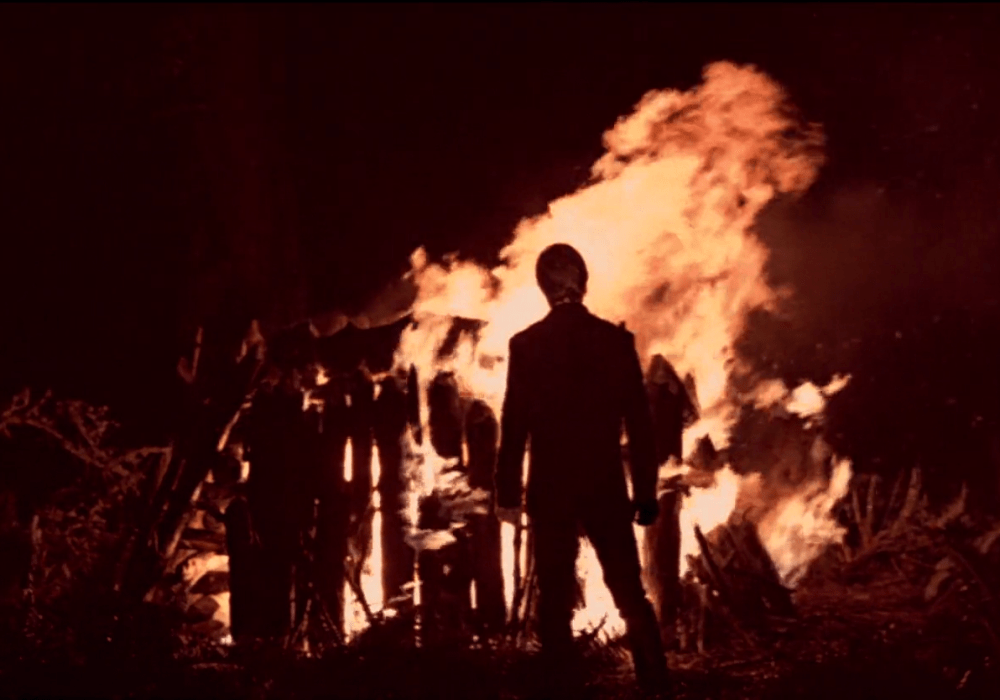
Re-watching Return of the Jedi (1983) as an adult makes the scene where Luke burns the body of his father stand out as the true climax of the original trilogy- the culmination of Luke’s journey. While it may seem tragic that sister Leia wasn’t there beside him, this was something Luke had to do alone. After all, it was only Luke who saw the human face of his father and bore witness to his humanity- only Luke would have been able to understand his father. Luke delivering his father’s funeral was his final rite of passage into manhood, and the true return of the Jedi.
Every man will have to bury his father, but will every man have understood his father when the time comes? The evolution of a man’s relationship with his father mirrors Luke’s struggle with Darth Vader throughout the course of the Star Wars saga- from not truly knowing him through the inevitable conflict of a young man’s transition to adulthood. If you’re lucky you’ll have a moment where the pieces come together and you see your father as a part of yourself- but not everyone gets there… and, unlike a Hollywood movie, the story may end first.
Luke learning his father was Darth Vader, galactic overlord, was shocking enough to cause a suicide attempt. The perceived failing of his father was more important to Luke than Vader’s identity as father. Culturally we understand men primarily through the contributions which they offer- only women are bestowed with inherent social value. Vader failed Luke by virtue of running the Empire- to silly Luke, this was the antithesis of value- and thus invalidated Vader’s status as a father to him.
Of course you would have jumped at the chance to “rule the galaxy together as father and son,” but Luke was a stupid motherfucker.
Our modern conception of fatherhood may be less dramatic, but it’s not very different. When a respect for fatherhood isn’t something institutionalized- ours is a world where Father Knows Best (1954) is treated like a bad joke- we default to a father only being worth what he’s able to contribute. Problematically, this contribution is judged by those who may not be old enough to understand the bigger picture: the reason why unpopular decisions are necessary.
Women raise children, and men raise adults. The connection a child has to their mother is drastically different than the relationship developed with their father. Like a woman’s social value, the relationship she has with her children is inherent- bestowed by nature. Biologically, a man is a sperm donor- fatherhood is a social construct.
So it follows that a boy will first get to know his father through the lens of his mother. The purpose of the patriarchy as a familial structure wasn’t male dominance through brute force, having women relegated to a role between sex slave and house keeper, but rather as way to guarantee that fathers wouldn’t be excluded.
The expectation for a wife was to have respect for her husband- “for better, for worse, for richer, for poorer, in sickness and in health”- in our modern world it seems appropriate, and rather pressing, to add “in times of strength” and “moments of weakness.”
The father you knew wasn’t the man who attracted your mother- attracting a woman is the easy part. You put your best foot forward- you accentuate the positives and hide the negatives; you do everything in your power to embody the fantasy she has of the perfect man. It isn’t an act- this man is someone you’d like to be, and her attraction makes you feel confident in that identity- you strive to be her rock.
But life is hard, and every man will stumble; he’ll feel defeated, he’ll question himself- and he’ll find it increasingly difficult to hide these feelings from his wife. When respect was her responsibility it may have encouraged him to fight, but in the wild west of a post-patriarchy, she’ll more likely resent any sign of weakness. In the dance of mating and courtship, women are those who select, and she’ll be irritated thinking she chose a buffoon. In a world where divorce is an easy escape, she’ll wonder what if.
I remember standing next to the eggs, at the supermarket with my mom, when I was twelve. We ran into my best friend’s mom. She was buying eggs too. They got to chatting, and within a minute or so, she tells my mom that she never wanted to marry my friend’s dad- he was a good guy, but he was boring– he was her back-up plan. Her main choice wasn’t interested, but now she wonders what if. Then we picked out our eggs and went to the check-out.
In all fairness, the guy was seriously boring.
The father you met was a man who had been through a lot- was the mother you had the type to respect him through his struggles, or wonder what if?
Maybe I’m a cynic, but Welcome to Hell (2021)– where a son’s perception of his father will be tainted by his mother’s disappointment. As a teenager, and the inevitable conflict inherent to those years, a poor foundation for this relationship will only worsen. If you think your father is a weak loser, suddenly a weak loser is telling you what you can and can’t do- for reasons that aren’t immediately apparent.
And that’s if your father hasn’t checked out entirely.
Shaping the image of your father through the eyes of your mother created a man only worth what he could do for you. His failings became magnified; you defined him through his shortcomings. As implicit as these feelings may have been, they seeped into the cracks of your relationship and weakened it. This may have further damaged a man already struggling to be the father and husband he needed to be.
You surely had a moment, as a young adult, where you saw parts of him in yourself and were horrified; like Luke in The Empire Strikes Back (1980), when he sees his own face in Vader’s mask- you experienced the fear of becoming your father. This was something you wanted to fight against. Your father was a weak man; your father was the villain.
I remember when I first saw things in my father that my mother couldn’t see- maybe things my father, himself, couldn’t understand. As I got older, I became more in touch with what was lurking under the surface of particular emotions- why I felt the way I felt. The insecurities, the sadness, the self-doubt. A marker for adulthood may be understanding the true challenge of adulthood- understanding that a man’s life is defined by struggle.
Take a moment to recognize that your father was alone in that struggle. He didn’t have the connectivity and resources of modern technology which has served to foster a re-emergence of masculinity and an understanding of gender dynamics. He was taught that his generation embodied a better way of thinking, and a good man was one who embraced this progression. Gone was the responsibility to lead a relationship- his generation embraced an equal partnership. A good man was a compassionate man who respected his wife’s strength and independence, and in-turn she would forgive his moments of failure and weakness.
Just like you, all your father wanted was to be a good man.
And as this way of thinking slowly destroyed him, it was all he knew.
When Luke looks down at his robotic hand, reminiscent of his robotic father, after striking him down as the Emperor cackles, he finally gets it. Life is hard, and Vader was only a man- not an impossible ideal to embody, nor a man only worth the sum of his contributions. Vader was a man, like Luke, and a man only Luke could understand- if not for Luke’s empathy and compassion, Vader was alone in the galaxy.
It may not be as dramatic, but it’s just as heroic- your father only has you.
Follow me on Twitter @ KillToParty
Support KTP through my Amazon link
 KTP
KTP 
Thanks man. This actually helps quite a bit. I’ve been struggling to deal with my old man. I get to work with him every day in our business but the guy is so solidly blue (with a sprinkle of red) that it drive me nucking futs. However, my mother is a full blast 2nd wave feminist, so there’s that. Keep up the thoughtful posts.
Excellent piece.
Thank you!