“Sometimes the only thing we counted on when no one else was there”
Crying at the end of Fraggle Rock (1983) is one of my three earliest memories. I would watch in my parents bedroom. It was on at night. I loved feeling ensconced in the Fraggles’ world; I wanted to get lost in their winding caves. For an only child going to a school outside of the neighborhood, weekday afternoon friends were non-existent; The Fraggles are what felt real to me. At the end of every episode, I wouldn’t want to go to bed. I didn’t want to leave the Fraggles. I knew I would fall asleep contemplating the death of my parents. It was a long time from now, they would tell me. They were right. While the latter was always subsequent to the former, these events seemed unrelated. Maybe I didn’t understand the pacing and structure of proper story telling; that a television show had a beginning, middle, and end; that the escapism of fantasy isn’t meant to last.
As a child these events seemed unrelated but now they feel inseparable. Telling one story must involve telling the other.
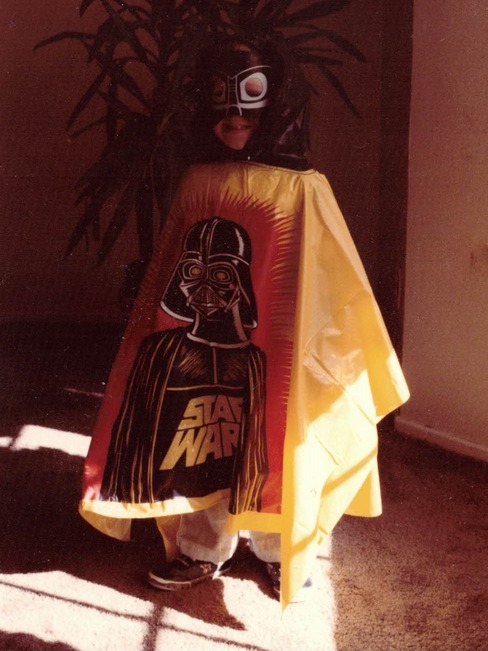
What I liked about Fraggle Rock was that I could make it my own. The characters didn’t live in the TV, in their fictitious winding caves, they lived in my head. They lived in my house: my mother, the ever-diligent, busy body Doozer; my father, the hulking, intimidating Gorg. My best friend, Chrissy, with her snow colored hair and icy blue eyes, was my Blonde Fraggle as we spent our Saturday afternoons exploring her cavernous basement. Our adventures were more important than what was on the television; our adventures with the Fraggles and the Muppets, and He-Man and She-Ra; fighting Darth Vader with cardboard tube light sabres; playing house in Fischer Price kitchens; having tea parities with Teddy Ruxpin and Grubby.
Fraggle Rock was Jim Henson’s most ambitious idea. Henson wanted to take his puppeteering to the next level, reaching a broader audience with a lofty mission: Henson wanted to “save the world” with a simple, good natured TV show. He wanted his show to have an international, globe spanning reach. To accomplish this Fraggle Rock was a joint production between three separate countries– CBC Television in Canada, Television South in the United Kingdom, and America’s very first premium cable network: Home Box Office.
HBO was its own ambitious idea. Prior to the network’s launch in 1972– a full decade before the Videocassette Recorder (VCR) began mass adoption– a movie’s original form was virtually forgotten once it left theaters. While some movies would eventually hit network television, they’d be cut up and censored with commercials for Swansons and Tide. HBO would show these movies uncensored and uninterrupted, along with live sporting events and concerts: all things that would have required a trip to the box office but could now be enjoyed from the comfort of one’s own home for a flat monthly fee.
My father was enamored with HBO; he considered himself a movie guy. He bought an early model VCR and would record movies on six-hour-long VHS tapes with pencil-written labels displaying meticulous timecodes. I don’t know if he ever managed to watch those tapes or if the tapes just served as cover for his secret pornography collection. Pornography was actually the premier driver of VCR sales in America– prior to this, porno movies could only be seen in filthy theaters with masturbating audience members. This created a Sophie’s Choice (1982)-like scenario for the average heterosexual man interested in sleaze. The advent of the VCR solved this problem and made pornography accessible to the aspiring degenerate. The porno theater was left to those unable to afford modern tech cohabitating with enthusiastic public masturbators. Luckily, my father did not fall into either of these categories to the best of my knowledge.
All of my first experiences with nudity came from HBO. Came from sneaking down to the family room in the middle of the night and using our cable provider’s awesome, wired, keyboard remote control– a commanders remote control; Captain Kirk’s remote control, surfing cable television with authority on the bridge of the Enterprise in his La-Z-Boy recliner and finding HBO.
The channel had been aware of the rise of pornography and committed their broadcasting array to be family friendly… well, mostly. HBO would not air R-rated movies before 8 PM, and they banned any movie with an X-rating. Still, they were battling for movie channel supremacy with networks who didn’t commit to such restrictive policies. Showtime would show R-rated movies all day long; Cinemax became known for cheaply made erotica. Playboy magazine would eventually launch a cable channel dedicated exclusively to soft-core porn and heavily edited hardcore (edited per 90’s era FCC regulations: all shots of genitals were removed, rendering it merely OOH and AHH facial reaction shots). HBO had painted themselves into a moralistic corner.
But like all things both corporate and moralistic, they managed to find a suitable workaround that rendered their posturing superficial. HBO would air late night content with tons of naked boobs. These movies would typically have thin plots and poorly executed comedy, but even one pair of big ass 80’s boobs made your ninety minutes well spent. I remember commandeering the giant remote, guiding our impressive 32” Zenith to HBO, and finally seeing what Suzzane Sommers had been hiding under her tight, braless, spandex shirt. From that day forward, I have literally never stopped thinking about boobs.
Especially after rifling through my father’s meticulously curated movie collection, with its pencil-written labels and time codes. I was looking for Superman II (1980), the third movie recorded on a six-hour Kodak brand VHS (Kodak used as a means of ensuring quality– after all, my dad was a movie guy). To get to the end of the tape, I had to fast-forward through something called Blame It on Rio (1984)– what I can only assume was Hollywood’s answer to the rising popularity of porn.
Blame it on Rio was, for all intents and purposes, a porno movie without the penetration. Where Michael Caine is seduced by his friend’s gorgeous teenage daughter, whose perfect tits are on display throughout the film more times than anyone is bothering to count. The friend ends up okay with the whole thing because it’s revealed that he’s been having an off-camera affair with Michael Caine’s wife, completing the ninety minutes of middle-aged boomer dad wish fulfillment. HBO loved this kind of sham content used as a workaround to their anti-porn policy. To a horny kid, Blame it on Rio was a helluva find in their dad’s movie library. Kneel before boobs. I don’t think I ever made it to Superman II. Certainly not during my latch-key kid era, where I’d pop Blame It on Rio into the old Panasonic during Disney Afternoon (1990) ad breaks.
The dawn of the decade had brought with it a completely immersive, highly-addictive Candyland consumer pop culture met with the unprecedented accessibility of sexually explicit material… if you knew where to look. If you had the tools of the trade: a VCR and a cable TV subscription. All it took was a little bit of luck and determination. Raiders of the Lost Ark (1981), only you’re exploring your basement for a dusty old copy of Playboy. Scanning through your dad’s VHS collection with the patience and detail orientation of a forensic scientist. Hoping that Just One of the Guys (1985) would be showing on HBO– ready to hit record; ready to catch a shooting star.
Time alone was meant for Disney Adventures (1990); for cartoon friends and jerking off; Nintendo games and naked tits. As a child these things seemed unrelated but they now feel inseparable. These are the things that shaped a generation of men.
Telling one story must involve telling the other.
***
The United States peaked during Ronald Reagan’s second presidential campaign with his aspirationally beautiful, gorgeously cinematic campaign television commercial that led with the words: “it’s morning again in America.” The Morning Again in America ad featured average Americans, of differing age and social class, partaking in a variety of activities that would typically take place during an average morning in America. We see a man in a city exiting a taxi, holding a briefcase, ready to attend his corporate office job. He has a full head of robust hair. He’s young and virile. Maybe single, but he’s on the upswing and climbing the ladder. It’s fair to assume he finds tremendous content in his fair pay met with trustworthy job security; his hopeful future.
We see a farmer turning his tractor to the left while looking to the right. This shot is important because it makes farming look high action and fun. The viewer, presumably not a farmer, may take a moment to think: what a nice life. We understand the farmer may be earning a leaner income than the corporate office guy, but we also understand that he is no less content.
Caught in a single shot and masterfully framed, we see a paperboy making his morning deliveries while riding a bicycle and a middle aged man leaving his modest suburban homestead, dressed in a business suit and holding a briefcase. This man is older and balding. We can assume he’s happily married, with kids and maybe a dog. We see him getting into the passenger side of a station wagon. He greets the driver with a wave before opening the door. He’s carpooling, presumably with a friend. The viewer understands that people in America have friends. Since his friend is driving a family truckster, we can assume the friend also has a family. People with family and friends are content.
In the next shot, we see another station wagon pull up to a colonial house. This car is arriving, not departing, communicating to the viewer that while many Americans go to work in the morning other Americans do other things. The station wagon has a small trailer hitched to the back of it; we understand that this American has something to do. We see a man with graying hair– a young grandfather– and a little boy, presumably his grandson, each carrying an end of a nice looking rug. The grandfather couldn’t have carried the rug on his own; he needed the help of his grandson. We assume this little boy will grow up to be a hard working American and may, at some point, take a moment to reflect on having internalized a sense of grit and perseverance during this shared morning with his grandfather. They pass a gorgeous rose bush on the way into the grandfather’s equally gorgeous colonial house. This man has retired to prosperity with a variety of hobbies that are personally fulfilling. This man is content.
We see a grandmother attending the wedding of her grand daughter. After the newly married couple leave the church to excitement and well-wishes, the grandmother and grand daughter embrace– this is the greatest morning of their lives. Immediately following the embrace, we see a shot of the White House at dawn and a montage of American flags being raised around the country: one outside a log cabin at a national park, another raised by a firefighter at a fire station, and finally a different grandpa raising the flag outside of his home. The juxtaposition of the embrace met with the American flag implies causation; these events are inseparable. Telling one story must involve telling the other
“Morning Again in America” is the single greatest presidential campaign ad, made at a time when the living room TV was the central component of any American household; Ronald Reagan was the ultimate TV president.
Elected at the dawn of the decade, Reagan felt like John F. Kennedy’s final form. While Kennedy had been the first television friendly politician, Reagan was an actual Hollywood star. His greatest strengths were his looks and charm: his screen ready presence; his ability to deliver lines with a stirring grace. Embodying the Platonic form of the ideal grandfather, Reagan’s presentation was kind but firm; masculinity tempered with a childlike wonder. Ronald Reagan most loved freedom, space shuttles, jellybeans, and big, corporate capitalism.
On January 28, 1986, six years deep into Reagan’s gorgeous cinematic presidency, every school aged child in the country watched the space shuttle Challenger explode live on TV. On bulky televisions strapped to push-carts in elementary school gymnasiums with concerned teachers scurrying to cut the power, hoping to erase the prior 73 seconds from existence, but it was President Reagan later that night who properly contextualized the event. He addressed the school children watching directly, addressing me directly, conceding that sometimes “painful things like this happen,” and that it’s all “part of the process of exploration and discovery.” The doomed mission was “taking a chance and expanding man’s horizons.” He concluded: “the future doesn’t belong to the fainthearted; it belongs to the brave.”
Reagan had a sincerity foreign those who succeeded him. He (seemed to) believe what he was saying while delivering what he said with perfection. Reagan’s (theoretical) sincerity served as an invisible foundation for that delivery; it carried immeasurable emotional weight. When understood as the living embodiment of everything America was meant to symbolize, only with the big budget grandiosity of a Hollywood summer blockbuster, Ronald Reagan was the greatest president we will ever have.
Over five-hundred years after the advent of the printing press, it was Reagan’s love of big corporate capitalism that truly birthed the modern world. Reagan wanted to author a new America made from the ground up, shaped in his own vision with a free market guided by his own sense of morality. Reagan felt it important that corporations market products directly to children and thus relaxed FCC regulations on advertising during children’s television programming.
It was now, during Reagan’s Saturday morning in America, that cartoons could serve as commercials; that commercials could appear like cartoons. It was this hallucinogenic blend of content and advertising– no lines drawn distinguishing the two– that created a myriad of beloved animated franchises. Cheaply made syndicated TV episodes interwoven with toy commercials serving as explicit markers pointing directly toward Toys “R” Us store shelves. It was this manipulative corporate synergy that drove the last great bastion of imaginative fantasy world building– the worldbuilding of modernity.
The creativity driven by corporations hungry to capture the emerging “Barbie dolls for boys” market ended up creating some tremendously cool shit. Taking the lead from Kenner’s phenomenally successful line of Star Wars (1977) toys, Mattel wanted its own franchise but one that didn’t need a license; one they could own themselves and thus created He-Man, Skeletor and the fantasy world of Eternia. Hasbro wanted a two-in-one toy line: robots that could double as vehicles. They bought the rights to a line of Japanese toys that did just that and hired Marvel to write characters and back stories and thus the Transformers (1984) were born. The year prior, Hasbro relaunched its clunky, outdated G.I. Joe line as pocket-sized 3.75-inch figures. They were perfectly scaled for the imaginative child to battle their Star Wars toys with, which was a clever selling point, but it was the realization that the Joes needed a perennial in-universe antagonist that created Cobra, and with the iconic villain G.I. Joe: A Real American Hero (1983) took on a life of its own.
Reagan’s vision of a perfect world was one that commercially exploited children. This created a highly addictive, hyper-realized consumer culture; kids crushing up breakfast cereal marshmallows under Disney dollars and doing lines with Sour Punch straws. Everything was commodifiable; everything a new impulse and desire. One couldn’t simply watch He-Man without wanting to hold Skeletor. One couldn’t see the dramatic first appearance of the Dinobots in “S.O.S Dinobots” (s01e07) without demanding a trip to Toys “R” Us to see the lifeless, scaled down, plastic molds in person. Even if you knew your parents weren’t going to let you take one home, you still needed to see them. Study their beautifully designed cardboard boxes with a silent, art gallery-like etiquette. There were no words adequate enough to capture the excitement you felt the day your mail-away hooded Cobra Commander came after eight long weeks– an eternity for a six-year-old. You could never own just one of the Constructicons: you needed fucking Devestator.
We wanted what we saw on television; we wanted these things because we saw them on television. What we saw on television became our framework for understanding the world around us: all things made equal when presented as content attached to tiny snippets of a never ending prize catalog. We saw life as a series of consumer choices. These consumer choices, when in combination, created the people whom we became; our media interests and product loyalty made us unique.
We understood our future as a predestined path unfolding slowly with each gradual marker of progress– going to college and getting laid; starting a career and getting married; buying a house and having a family– as check points built into the game. An open world for us to explore, and enjoy, and get lost in its winding caves; a sandbox experience with quests we could conquer at our leisure. Life was a Choose Your Own Adventure (1979) novel with a multitude of endings and all of them were happy.
***
The darkness outside my living room window is my second earliest memory. How the streetlights reflected off the pavement. The desolation of a suburban street after dark. I would wait by the window for what felt like a thousand lifetimes. Alone with my stuffed beagle, whom I named Barkey, not because dogs bark but because I couldn’t properly pronounce Barkley, the shaggy dog on Sesame Street (1969), and I’d wear out the retail tag, the one you’re not suppose to remove under threat of imprisonment, by running it through the crease between my index and middle fingers as a way of self-soothing. If I give this memory enough space, I can still feel little bits and pieces of it.
The earliest memories are like fuzzy still images. Copies of copies, with each remembrance, and the years in between, chipping away at the picture’s resolution until all that’s left are the feelings attached. Evasive feelings buried deep enough to be out of reach and too distant to reckon; to find the right words to capture. Ghosts that dwell and haunt for a lifetime. The darkness outside my living room window, waiting for my mother to come home– hoping that my mother would come home. The dread I felt, in my bones and on my chest. It was a long time from now, they would tell me.
My father would be passed out, unconscious, from having taken swigs of vodka from a hidden bottle in the garage since the early afternoon. Everything came down on the two of them, at the same time, shortly after moving to the suburbs and having their first, and only, child. My father was fired from his big city sales manager position. He would sometimes remind me he ran the “biggest office of a Fortune 200 company” when he was drunk and feeling sorry for himself. This rendered all of his Salesman of the Year awards, which he hung over his workbench in our basement during the tiny sliver of the Venn diagram that included both home ownership and prestigious employment, as painful reminders of what could have and should have been for all of us. From that point forward, we were on the shit end of an alternate 1985 without a flying Delorean to make things right.
My father became someone else when he was drunk. Someone I never got to know. Someone I never wanted to know. Someone I hated with every bit of myself for possessing the person I had known as my father. Someone I felt such a deep sadness for that once I acknowledged the feeling and allowed space for it to dwell, it would haunt for a lifetime.
At four years old, the darkness of the house felt encompassing; the size of the house, incomprehensible. The night would feel as though it could stretch out into infinity with each passing hour serving as a significant portion of my life. I never felt more alone than in these moments. It was a long time from now, they would tell me.
It was on one of my Indiana Jones and the Temple of Doom (1984) basement expeditions that I came across a newspaper article that my father had clipped; he was in the inset photograph with a proud, goofy smile. He was featured as a man on the street for a filler column where reporters asked random people random questions. My father was asked what he thought made for a great marriage. He answered, without hesitation, that a man should make his wife happy. In turn, he went on to explain, his wife would recognize and appreciate this gesture, and believing in the general spirit of reciprocity, go on to make him happy. In retrospect, he was probably making a blow job joke. My dad was that kind of guy. I’m not sure if he experienced any of the above first hand or if he was just spitballing. He had the newspaper clipping framed and it hung above his workbench in our basement beside his numerous Salesman of the Year awards. My dad was that kind of guy.
Just one year after I was born my mother was diagnosed with breast cancer. She survived with surgical intervention combined with long chemotherapy treatments. I am grateful for this every day of my life. Doctors told her that she couldn’t have another child, so our family remained at three. As a child, I didn’t know the difference nor would I have understood the profound scars that this ordeal left behind. As an adult, I know that my parents were not the same people after my mother had cancer. In a way, I’ve never really met my parents.
At night my mother would leave for work. She had a job at the photography studio at our local shopping mall where she’d sell overpriced photoshoot packages to gullible families. With her position she received an employee discount– awful, oversized pictures of me frozen smiled, staring at bubbles and toy trains adorned our living room for the next twenty years. My mother had pictures of me everywhere: in her bedroom, in my bedroom, in our family room. She loved me with a desperate intensity. After she left, I’d watch TV until it was dark, and my father was so thoroughly unconscious that he looked dead.
It was a long time from now.
Sitting by the living room window, with the street lights glaring off the empty street, and waiting for my mother to come home from the job she needed to keep our family alive, with my stuffed beagle, running the tag through the crease in my fingers, with thoughts of the Fraggles and the Muppets, and Christmas and Chrissy, and my mom and dad. The way I wanted them: safe and happy. All of us together, was probably my final thought for the night, by the window, as I was carried off into dreams.
Follow me on Twitter @ KillToParty
Support KTP through my Amazon link
 KTP
KTP 
The beauty of your writing fills me with a profound ache for the past. Gratitude.