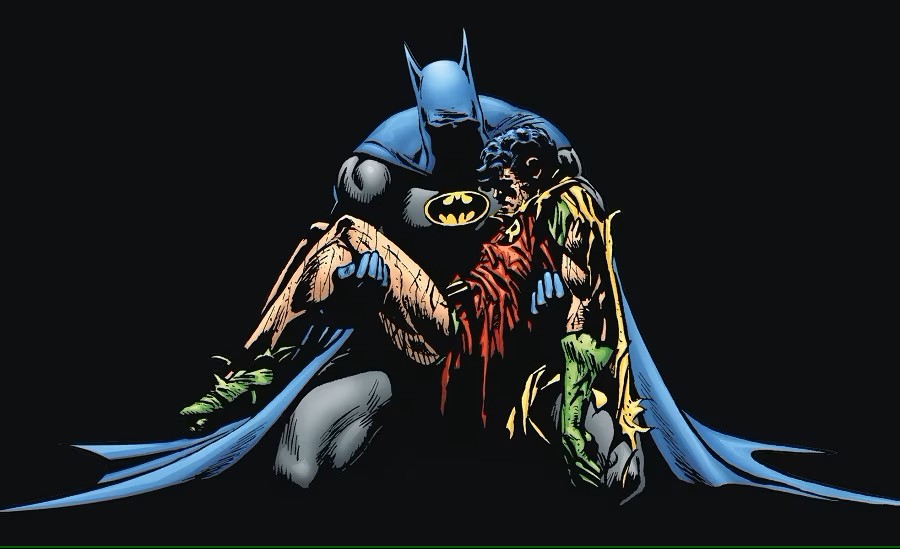
“…and the dead lay in pools of maroon below”
My mother and I would come to spend our Saturdays together. We would go out in the early afternoon to different stores or the mall, or to a park, or the beach during the summer. We’d go to a restaurant for dinner, maybe Friendly’s, and we’d be home before network television’s prime time lineup. My mother would usually fall asleep sometime during Empty Nest (1988-1995) or Golden Girls (1985-1992), and I’d be up laughing by myself. She was my best friend– if she didn’t have me, she’d have been alone.
We would come home to find my father passed out– if you didn’t know better, you’d think he was dead. The remnants of the dinner he made for himself would be on the stove. He liked salisbury steak. My mother would use these Saturdays as a reprieve from the brutality of her week. My father would use them to drink. He existed separately from us. He was alone.
It was on a trip to our local flea market that I found Batman: A Death in the Family (1988)– it became the first comic book I ever owned. Like all boys, I liked superheroes. I liked superheroes, but I didn’t like watching superhero cartoons anymore– while the characters made the mind race with excitement, the delivery of their stories felt childish. Even the more forward thinking, 90s orientated Teenage Mutant Ninja Turtles (1987-1996) didn’t have enough attitude to make up for its sensibilities. The content wasn’t delivered with maturity– no one got hurt and no one died; on Saturday mornings, even turtles never bled. There were no stakes, and I knew it, but A Death in the Family felt different.
A Death in the Family felt real.
The cover was striking: against a glaring black background, Batman appears at the masthead in plain, unremarkable lettering. Lettering that communicates the serious nature of the work– this is serious business; we are not here to have fun. A Death in the Family, written in red, is vertically descending so that death and family are given their own lines and proper emphasis. Under the title, Batman is depicted on his knees, head down and face shadowed, holding the bloodied body of Robin while communicating the cover’s final message: in this book you are going to see Robin die.
I internalized the following lesson with immediacy: superhero cartoons were for kids; superhero comic books were for teenagers. While nothing ever happened in the cartoons– every conflict resolved itself in a single episode– it was within the pages of comic books that things could happen. Things did happen in comic books. The evidence was there in front of me. Characters died in comic books.
I knew I had to see Robin die.
I had to see Robin die because Robin was a dumb character to begin with. Robin was only considered a necessary part of the Batman presentation due to the cultural saturation of the 1960’s television show that was still in syndication by the end of the 80s. The average adult would have considered Batman and Robin an inseparable pairing. An average adult would not have considered Robin any sillier than Batman because, to an average adult, all of this was silly– superheroes were inherently silly. Robin was no sillier than the rest.
A teenager, however, would interpret things differently. Teenagers take Batman seriously. Teenagers understand Batman on the conceptual level as plausible– Batman as the story of a fortunate man driven to the outer edges of sanity by unfortunate circumstances and when left with no other option takes vengeance upon the city’s criminal element under the cover of night. A teenager would consider this a reasonable response to tragedy. Batman is how a teenage boy understands morality, necessity, and duty. Under these exact circumstances, Batman was something that could happen but not Robin.
Robin was ridiculous.
Like Bruce Wayne, Dick Grayson has a tragic origin story. Eight-year-old Dick worked along side his parents at a circus. They were acrobats. Unbeknownst to the Graysons, the mafia was extorting money from the circus. As a disproportionately harsh preemptive warning to the circus owners, gangsters killed both of Dick’s parents. After investigating the double murder, Bruce Wayne adopts the young boy. This would have worked had the story ended there: Bruce Wayne with an adopted son, finding a renewed purpose which acted as a counterbalance to his brooding Batman persona. Having a son would give Bruce Wayne depth; Batman a greater sense of realism… but that isn’t how things played out.
Instead, Bruce creates a silly costume and has an eight-year-old boy help him fight street thugs at night. If the Batman series managed to unwittingly achieve even a vague sense of realism, the introduction of “Robin, The Boy Wonder” kept things rooted firmly in the ridiculous.
It was the teenage boy who blamed Robin for why the Batman live-action television series wasn’t any good– the show was silly and camp. The show didn’t take itself seriously or give proper reverence to the source material: the tragic, brooding Dark Knight. The show was barely watchable even when considering the shallow smattering of Sunday afternoon network TV options. I would watch it when my mother took me to visit my grandmother. She didn’t have cable. I would watch while silently acknowledging that the show was bad because of Robin.
The teenage boy rejected Robin. The teenage boy wanted a serious Batman. The presence of Robin undercut the teenage boy’s ability to believe in Batman– to get lost in the darkness of Gotham.
In an unprecedented move, DC Comics allowed the reader to decide the fate of The Boy Wonder.
At the end of Batman #427 (1988), there was an advertisement for a telephone poll with the following ad-copy: ROBIN WILL DIE BECAUSE THE JOKER WANTS REVENGE, BUT YOU CAN PREVENT IT WITH A TELEPHONE CALL. One 900-number was given the caption “The Joker fails and Robin lives,” and the other had the caption “The Joker succeeds and Robin will not survive.” Below the text, Batman is depicted as angry and determined, holding an open-mouthed Robin who’s in an ambiguous state of consciousness. At the bottom of the page it’s noted that each phone call cost fifty cents– one third the price of a comic book at the time.
Teenage boys voted for Robin to die.
***
Michael Ortega was unusually ecstatic the first day back from Christmas break. He could hardly contain his excitement while standing on the boys’ line by the flag pole. He had an incredible Christmas, he told us. He wanted to impress us. He placed a deliberate emphasis on the word “incredible.” An incredible Christmas– everything he got was Teenage Mutant Ninja Turtles, he said. There were no filler gifts– not this time, not for Michael Ortega. He couldn’t believe his luck– an incredible Christmas. Everything was Ninja Turtles, he reiterated. He got the Technodrome and the Party Wagon. He got the sewer playset. He got Teenage Mutant Ninja Turtles socks and underwear. He rolled up his pant leg to show us his sock. We were in seventh grade.
We were in seventh grade, and the rest of the boys got heavy metal cassette tapes and violent video games. I got a Sega CD with Sewer Shark (1992) and Night Trap (1992). Teddy, always the forerunner, got a compact disc playing stereo with heavy metal compact discs. We were all very spoiled and fortunate, and we received the news of Michael Ortega’s treasure trove of Ninja Turtles gear with derision. We were in seventh grade.
We were in seventh grade, and it was only a scant few months prior that we would have loved having Michael Ortega’s incredible Christmas. Things change quickly in a boy’s life. One morning you wake up and decide that you need something harder– harder than the turtles; harder than Nickelodeon; harder than The Dynamic Duo; harder than things made for children. Your emerging adolescent eyes pierce through the veil of pandering condescension with the obliterating brutality of Superman’s heat vision.
You want what the older kids have; you want to do what the older kids are doing. You want to experience what so far has eluded you; what’s been inaccessible to you; what you’ve only seen in glimpses and flashes in movies like Ferris Bueller’s Day Off (1986) and License to Drive (1988). You want to be a part of the secret teenage world– you want to be ensconced in it; to get lost in it. You want what you feel entitled to; what you consider your destiny: feeling up a girl in the back seat of your mom’s Toyota Corolla.
You don’t want to wait, and by seventh grade you feel like you’ve been waiting an eternity. You don’t want to wait, and as you gaze upon Michael Ortega’s hairless calf and Pizza Party Time sock, you seethe with frustration. You don’t want to wait, and by seventh grade you’ll take what you can get: blood and rock n’ roll.
It was something my entire elementary school class decided in collective unconscious unison: music is the hallmark interest of the teenager. This mindset began its evolution early and grew with an organic graduality. One day in fourth grade, the girls decided they liked New Kids on the Block. New Kids on the Block branded merchandise spread throughout my fourth grade like cancer cells tearing through flesh: denim jackets, Trapper Keepers, and lunch boxes. Even the boys liked New Kids on the Block; even the boys had their branded merchandise. The boys, except for me and Teddy.
Teddy and I liked hair metal– Teddy and I liked Motley Crue, Skid Row, and Poison. Simultaneous to the New Kids on the Block supposedly introducing ten year olds to the secret teenage world, hair metal was peaking in popularity and giving kids something closer to the real deal. Even if the New Kids were teenage-coded, it was all smoke and mirrors– their act was G-rated. Hair metal was pushing a hard PG-13. Hair metal was the real deal.
Hair metal, although a derisive label, is used here delicately and with neutrality. Hair metal because the image these bands presented stood on equal footing with their music. These bands existed exclusively in a post-MTV cultural landscape– image was as important as product, perhaps even more important. Perhaps the image was the product. Hair metal because these bands took on a near identical visual aesthetic. Hair metal because these bands styled themselves to look like women with big hair and overdone make-up. This was considered very cool in the smack dab middle of the Reagan 80s.
Teddy and I enjoyed the rock star posturing and air guitar jamming, but it was the music that captivated us– we were music guys. While there may be no better term for the over-produced, radio friendly pop-metal that dominated MTV during the 1980s, calling it hair metal unfairly allows the casual listener with unearned pretentions the ability to be cruelly dismissive: all but those who stuck around after the genre’s sudden collapse of mainstream appeal consider hair metal absent of merit.
The truth is that hair metal rocked. Hair metal is the soundtrack to a party so perfect it could only be considered the Platonic ideal; a party so perfect it could only exist in the movies– in your idealized memories twenty years later. Hair metal is a preview of what’s to come for the sexually frustrated twelve year old boy– a promise so convincing it seemed to hold contractual obligation. Hair metal is the soundtrack to your day dreams. Hair metal is girls and cars. Hair metal is the endless Friday night; the eternal summer; the first kiss with your first love.
To love hair metal is to love life.
Hair metal is the logical progression of what KISS introduced to rock music in the 1970s– a sharp focus on a hyper-realized, theatrical image met with songs about sex written in coded language and double entendre: the song “Nothing to Lose” is about Gene Simmons’ attempts to coax a girl into having anal sex; Paul Stanley named an entire album after a reference to his penis. The following generation’s hair metal bands copied this formula with precision and without shame. Teddy and I thought this was badass– surely, we thought, this was how cool teenagers talked about women.
We wanted to be cool teenagers.
Cool teenagers knew Skid Row’s “Big Guns” was about a man’s infatuation with large breasts; that “She Goes Down,” a throwaway track on Dr. Feelgood (1989), was about blow jobs. We felt cool knowing Poison’s “Talk Dirty to Me” was about talking dirty. That meant sex.
As aspiring cool teenagers, even with several long years ahead in the prison-like hell of childhood, we knew these songs were a window into what life would become. Even if we were already armed with a vague conception of our own genetic limitations, we knew we would eventually have girlfriends. We knew we would get laid. We knew we’d have adventures and misadventures; we knew we’d have crazy, crazy nights. We knew life would land somewhere between “Nothin’ but a Good Time” and “Dr. Feelgood”… Somewhere between the two but never in the jungle, aboard the “Nightrain,” or riding the “Rocket Queen.”
Unlike other hair metal bands, Guns n’ Roses weren’t trying to be relatable. Appetite for Destruction (1987) didn’t hold the keys to a teenaged future– Guns n’ Roses weren’t meant to be aspirational. When Poison would sing about partying and Motley Crue would sing about strippers, the idea was that the listener could relate. These rock stars were the idealized everyman; the coolest guy at your high school; the big man on campus; the template all teenage boys aspired to embody. Guns n’ Roses were something different. Appetite for Destruction doesn’t meet the listener on the listener’s terms. Instead, Guns n’ Roses gives the listener a voyeuristic glimpse into a foreign world: the world of a drug addled, dirt bag, nightclub rock star spelled out in explicit, raw detail. Guns n’ Roses weren’t trying to be relatable– Appetite for Destruction is alienating. Guns n’ Roses were monstrous.
Appetite for Destruction documents singer Axl Rose’s introduction to Los Angeles. William “Axl” Rose was born in Lafayette, Indiana– Axl is originally from the smack dab middle of America– and relocated the City of Angels to pursue a career as a rock singer. Album opener “Welcome to the Jungle” details Axl’s first impression of LA: sex, drugs, and violence. Appetite for Destruction begins at the end of Axl’s journey from innocence to experience. The only hint of William Rose Appetite for Destruction offers is in its first few seconds– we hear William’s reaction as he steps off the bus from Indiana; his shock at the vicious immediacy of Los Angeles:
“oh my God…”
From here “Welcome to the Jungle” hits like a bullet. “Welcome to the Jungle” is a letter of warning written by Axl to his former self; a warning of the omnipresent dangers hidden within the excesses of Los Angeles. A prescient warning that these excesses will overtake his former self– to what extent, Rose never makes explicitly clear even when appearing to do so:
“You know where you are? You’re in the jungle, baby. You’re gonna die…”
Is Axl referring to his own violent death– an overdose, a drunk driving accident, a murder– or something more delicate? Is Axl referring to the erasure of his former self? Was Axl afraid he would lose himself entirely to LA, or is he committed to reveling in debauchery to the end? Axl lets this question linger; Appetite for Destruction allows the listener to decide.
The rest of Appetite for Destruction hits like an atomic bomb. Rose details the bands exploits with women, alcohol and heroin. These extremities, the characteristics of the rock n’ roll lifestyle that Rose animates Los Angeles with, were not meant to be relatable to the average Guns n’ Roses listener– the white, suburban, 16-24 year-old male– nor were they presented as a glamorous lifestyle worth pursuing. Instead, Axl Rose presents the darker themes of Appetite for Destruction in plain language and through an amoral lens; a gritty, dark, and dirty lens. Appetite for Destruction is the documentation of Axl’s life– Axl Rose’s diary made lyrical and set to music– lending it a higher degree of authenticity than anything his peers were capable of at the time.
Guns n’ Roses felt real.
Teddy unfolded his cassette tape foldout and made a box in black ink around every use of the word fuck and every obvious reference to sex or drugs. It was in the foldout that he found the words: “with your bitchslap rappin’ and your cocaine tongue, you get nothin’ done.” He drew a large box around this gem hidden deep within the liner notes: he liked that it contained both the words “bitch” and “cocaine.”
After we heard Appetite for Destruction, our rock star posturing and air guitar jamming became exclusively dedicated to Axl and Slash. Teddy would hold his toy shotgun like a guitar and I’d do my best Axl Rose. We’d pretend our pretzel sticks were cigarettes; our little cups of Pepsi were whiskey. We’d get boxes of Good & Plenty, for their medicinal color scheme, and pretend they were “drugs.” We’d cut lines of Pixie Sticks and snort them through Sour Punch Straws– we were music guys.
We’d listen to Appetite for Destruction while playing Nintendo– the album’s closing track, “Rocket Queen” never failed to give me chills. As the song eases into itself with a prolonged instrumental section, the sounds of live sex are mixed in with the music. Axl had sex with a woman in the vocal booth of the recording studio to layer over this last track. For the album’s final act, Axl Rose wanted to make the listener a literal voyeur. We’d pause our game and listen with hushed excitement– this was something beyond the rest of the album; this hit harder and carried a greater depth of reality; we felt cool hearing it– but when the song switched gears to its sentimental coda, Teddy would quickly hit stop and flip the cassette back to side one. According to Teddy, the rest of the song was gay.
I never felt that way about the coda to “Rocket Queen,” even back then, but it was Michael Ortega’s hairless calf and Pizza Party Time sock that made me burn with irritation on the first day back from Christmas break while standing on the boys’ line by the flag pole. It was Michael Ortega’s incredible Christmas that gave me second hand embarrassment. We were in seventh grade, and our teenage years loomed in the air as wispy day dreams of a cruelly delayed future. A future we were forcing into existence by sheer, desperate will; throats burning with Pixie Stick drip. The Pizza Party Time sock, the hairless calf, the incredible Christmas were bad enough, but it was Michael Ortega’s naked sincerity that was too much to bear that morning by the flag pole.
It was Michael Ortega’s comfort with himself. Michael Ortega’s comfort with being a kid. Michael Ortega’s naked desire to still be a kid. Michael Ortega was okay with being a kid. Michael Ortega didn’t know any better, with his Ninja Turtle toys; the Party Wagon and the Technodrome; the socks and underwear. Michael Ortega wasn’t burdened by what was to come, he was happy with what simply was. It was this sincerity– this postureless content– that reminded me of what I was running from.
I needed to live in a space perpetually consumed with fantasies of the future– some idealized future of adventures and misadventures; girlfriends and backseats. I needed to feel a pointed distaste for the present. I needed to understand childhood as an obstacle to overcome: a long, dreadful inconvenience on the path to where I wanted to be. I needed actions taken to distance the past; to distance my present self. To quarantine him; lock him away and never look back, and for an awful moment on the boys’ line by the flagpole Michael Ortega made all of this impossible.
That morning we looked upon Michael Ortega’s naked sincerity with derision, his innocence as shameful. His thoughtless embrace of childhood as terrifying. Michael Ortega was everything we hated about ourselves.
***
Although I couldn’t verbalize it at the time, I knew why my mother insisted on seeing Medicine Man (1992), a wooden Sean Connery drama, the weekend Wayne’s World (1992) released to theaters. Medicine Man had opened the weekend prior, and it stands to reason that sometime during the intervening week she had seen commercials for it– she insisted on seeing it. She insisted on seeing it despite what I considered a concise and succinct, logically infallible argument: it looked boring. That little bit of resistance in weekend movie choice, the simple appeal to good reason, angered my mother– she had her heart set on seeing Medicine Man. Without reservation, she snapped at me and her tone indicated that I had done something wrong; I had spoken out of turn.
With the inertia of disproportionate anger, she said with pointed inflection that maybe Medicine Man would give her hope. Maybe hope is what she needed.
Despite not knowing what I had done wrong– despite feeling the assurity of possessing the correct opinion regarding new release cinema– I felt badly about this for the rest of the day. I didn’t like upsetting my mother.
I didn’t like upsetting my mother because I knew she depended on me. She had enough of my father to deal with; I wanted to make her happy. I wanted to be there for her– the times she would complain about my father; tell me she regretted marrying him. That I would someday need to tell some imagined judge, at some imagined divorce proceeding, that I am choosing to live with her and not him. That he’s a worthless loser. That he should drop dead. She would make me promise that I’d never drink; would tell me that alcoholism is genetic and inherited– make me promise to never drink.
She would tell me that I was going to go to college; that I was going to be successful. That this meant everything to her. That it was my job to make things right; to make up for their failings. That I wasn’t going to turn out like my father. It was my job to not turn out like my father.
I didn’t like upsetting my mother because I wanted to be there for her. I wanted to make her happy. She was my best friend– if she didn’t have me, she’d have been alone.
The next weekend, we went to see Wayne’s World. We both loved it.
Wayne’s World was the perfect movie at the perfect time. The 1990s were looking for something new to pin its identity to and characterize itself by which is how we’ve come to understand the idea of decades, conceptually, by the millennium’s swan song– a new decade brought with it a new aesthetic and a new attitude. A new decade brought with it a new culture which was scheduled to commence immediately following the champagne toasts and self-congratulatory pats on the back signifying a past decade well done. Just after the ball’s dropped we’re meant to realize, in collective unconscious unison, that the prior decade has become ancient and terribly uncool.
There would be new Coca-Cola ads; new Pepsi slogans.
The 1980s peaked with Michael Jackson’s Bad (1987), as if on schedule and by design, as a follow up to Thriller (1982), the album that defined the first half of the decade and sold thirty-two million copies in its first year of release. While this made Jackson the primary living embodiment of the decade itself, it came with tremendous pressure to follow up with something that would be as critically acclaimed and even more commercially spectacular– conditions that would be diametrically opposed in any decade that followed but their convergence was considered a common sense state of being in the 1980s: the best of anything was what was most popular; what was most popular was the best of anything. Ronald Reagan won forty-nine states in 1984– an impossibility at any future point and what most emphatically illustrated the prevailing philosophy of the 1980s: the best things were the most popular things.
The idea that Michael could top the success of Thriller was an idea that could only exist exactly when it did: on the back end of the decade, when it was still conceivable that big American things could only get bigger. His goal for Bad was 100 million copies sold, a number he’d write in Sharpie on his bathroom mirror as a constant reminder. A number that was never possible but also not completely ridiculous– at least not conceptually. It wasn’t so different than Reagan’s forty-nine states.
The fact that Michael couldn’t touch the success of Thriller with his excellent and critically acclaimed follow-up, Bad, was symptomatic of its release coinciding with an exhausted decade winding down. New energy was already beginning to manifest and this energy would grow with an organic graduality. The 90s loomed and the 90s were to be different.
The 90s would speak a language that Michael Jackson didn’t have the vocabulary to understand– a fact evident by how he handled music video production for Dangerous (1991), Bad’s follow-up. Jackson packed these videos with every major star of right then and there. The video for “Black or White” featured Macaulay Culkin from Home Alone (1990); “Remember the Time” had Eddie Murphy and Magic Johnson; “Jam” had a scene where Michael Jackson taught Michael Jordan how to moonwalk. While these videos were popular and Dangerous charted well, it didn’t capture the coming cultural zeitgeist; Michael Jackson was no longer perceived as being cool.
It didn’t capture the coming cultural zeitgeist like Wayne’s World.
Wayne’s World was the true start of the 1990s, so let me bring you up to speed. Wayne’s World is about best friends, Wayne Campbell and Garth Algar, who live in Aurora, Illinois, which is a suburb of Chicago. The duo, who are in their late twenties, still live with their parents, which is both bogus and sad, but they host an amazing cable access television show, the eponymous “Wayne’s World,” and they still know how to party.
The audience is introduced to Wayne, as he speaks this information directly to the camera, and the monologue ends on a wistful note: Wayne wishes he could make good on “Wayne’s World”; he wishes he could do his show for a living. “Wayne’s World” is all Wayne has to show for his life. Wayne Campbell has nothing else.
Through the show Wayne Campbell has found his passion. The rough around the edges, no-budget show has a punk rock vibe. The show is an underground sensation; “Wayne’s World” has an audience; “Wayne’s World” is popular. Wayne and Garth are treated like local rock stars. It’s only for the lack of opportunity that they aren’t able to make ends meet with their weird, off-beat television show. Hitting it big with “Wayne’s World” is Wayne and Garth’s happily ever after scenario. Their mega-happy ending.
Had Wayne’s World been made in the 1980s, the story would present with the same hallmark linearity that was characteristic of the decade itself. If Wayne’s stated goal at the beginning is to bring “Wayne’s World” to its apex, cementing the show as a viable path for Campbell to move forward– the convergence of passion and utility– the story’s end would have Wayne achieving this goal, along the way finding adventure and misadventure while meeting the girl of his dreams and capturing her heart. In the Reagan 80s, Wayne’s World would have been a straight forward success story– the mega-happy ending.
Only that’s not how Wayne’s World plays out…
Wayne’s World is a cautionary tale about the dangers of selling out– about finding the strength to walk away from success when it comes at the cost of artistic integrity. In Wayne’s World, Wayne and Garth are approached by sleazy television producer Benjamin Kane who proposes an ambiguous deal, offers contracts, and has checks made out for five-thousand dollars. Wayne Campbell isn’t able see this as a threat; Wayne is only equipped to understand corporate interest as opportunity.
Even if “Wayne’s World” is a television show, it’s spiritually a rock band. Before all else, Wayne and Garth are washed up 80’s rockers on the foreshore of the 90s. Wayne Campbell’s understanding of the world is filtered through the prism of music. Selling out wasn’t a thing in the Reagan 80s– big things only had room to get bigger; the best things were the most popular things; forty-nine states.
Corporate interest in “Wayne’s World” is so obviously the next step in a success story that Wayne doesn’t bother reading the contract. Who read contracts in the Reagan 80s? The local band signing the big record deal was universally understood as all things righteous and good in the world; the American dream, no legalese required. Wayne immediately signs with Benjamin and gets his five-thousand dollars.
However, the contract Wayne signed was to sell his show to Benjamin; Wayne no longer owns the eponymous “Wayne’s World.” Under Benjamin’s direction, Wayne’s warm basement is recreated on a cold television set, complete with a gaudy neon Wayne’s World sign, cheesy new theme music and an awful sounding television announcer introducing the two. Everything charming and low-budget about the show has been replaced with the mega-uncool TV friendly version. Wayne knows this sham production– this parody of “Wayne’s World”– isn’t his show. He storms off the set and walks away from all of it. Instead of playing by the rules and compromising his art, Wayne would rather lose everything. Wayne is not a sell out.
Wayne’s World is where the 90s truly began– where purported integrity became more socially advantageous than straightforward, meat-and-potatoes success. Wayne wins no further award nor concession prize by story’s end. Wayne gets the girl, but Wayne’s show is lost forever. Wayne learns that integrity is an end in itself, albeit fruitless and hollow.
Even if Wayne’s World was released five months after Nirvana’s cultural monolith, Nevermind (1991), grunge was not yet seen as a new philosophical paradigm quite yet. Wayne’s World actually served the 90’s first warning shot that big American things would not continue to get bigger– at least not in the traditional sense; not in the linear sense. America’s cultural landscape would no longer present as monocultural, even if monoculturalism was still the rule of law– everyone simply decided that they, alone, were the sole exception to monoculturalism, inexplicably and in collective unconscious unison. It became cool to act like whatever you liked wasn’t the most popular thing, even when by every metric it most certainly was. It became cool to believe that what you liked was counter cultural and underground even when it was getting round-the-clock rotation on MTV. Can it still be considered alternative rock if everyone is listening to it?
The prevailing notion was that there was someplace else in America were these other, mega-uncool people lived. Who liked mega-uncool things, and these people didn’t count. They existed for the sole purpose of pretentious derision by the rest of us who were much cooler and liked niche albums like Nevermind, which sold forty-two million copies in its first year of release. Wayne’s World, a movie about the ethics of low-budget, underground entertainment made $183 million dollars at the box office. What was cool to think wasn’t popular was actually very popular.
My mom and I loved Wayne’s World but not for its dissertation on artistic integrity nor its ode to underground art. We loved Wayne’s World because it’s a movie made of happiness. While Wayne may lament his inability to put the pieces of his life together, it doesn’t stop him from having a good time– he still knows how to party. Wayne and Garth are happy people; they find a way to have fun with whatever they’re doing. There is a perpetual lightness to Wayne’s World as we see the world through the eyes of Wayne and Garth. It is impossible to watch Wayne’s World without a smile plastered on your face. My mom and I laughed the entire time.
I loved Wayne’s World because I saw myself in Wayne Campbell. Wayne was what I aspired to be. Wayne was the cool adult who still has his love for music set squarely at the center of his life. Music was the center of my life when Wayne’s World came out and I assumed it always would be– I assumed I’d look just like Wayne when I grew up. Like Wayne, I wanted to grow up but I didn’t want to grow old– I wanted to always know how to party.
Wayne’s World works so well because Wayne Campbell was based on the real life of Mike Myers. Wayne’s World was so lovingly crafted because Mike Myers has an obvious love for his teenage self, so much that Myers insisted on using Queen’s “Bohemian Rhapsody” when the studio requested a more contemporary song for the film’s hallmark car scene because that’s what he did with his friends when he was a teenager– they drove around town being goofy and listening to Queen. They were music guys.
Wayne’s World worked so well that it made “Bohemian Rhapsody,” a song fifteen years old at the time of release, into a reborn hit single. I bought my cassette copy of Wayne’s World: Music from the Motion Picture (1992) from Woolworth’s unexpected, albeit paltry music section on a Saturday afternoon trip to the mall with my mom. I primarily bought the Wayne’s World soundtrack for “Bohemian Rhapsody.” The song was infectious, and the timing was tragically perfect– Freddie Mercury, singer for Queen, had died only three months prior. Two months following the release of Wayne’s World, FOX broadcast The Freddie Mercury Tribute Concert (1992) featuring performances by Metallica and Guns N’ Roses. I watched with my mom. The high point of the show featured Elton John singing a touching rendition of “Bohemian Rhapsody,” with Axl fucking Rose storming out for the loud, rockin part at the end. Even now, sitting at my desktop and typing these words over thirty years later, I have goosebumps. The moment was electric.
Back at the car, unwrapping my brand new Wayne’s World: Music from the Motion Picture cassette, I had a moment of overwhelming regret. There was an economy to choosing what cassette to buy on a Saturday afternoon trip to the mall. Times were tight. I could only sometimes wrangle a cassette purchase out of my mom; often she would only buy me a magazine, either pro-wrestling or video games. Cassette choices required heavy contemplation– quick mental math; impromptu pro and con lists made on the spot. I’d usually spend the entire time at the store in their music section looking over heavy metal cassette tapes with a quiet, museum like etiquette. My pick for that Saturday afternoon was the Wayne’s World soundtrack because it had three songs I knew I needed. The math made sense. I pulled the trigger.
I pulled the trigger with haste, I had realized back at the car, as I unwrapped my Wayne’s World: Music from the Motion Picture cassette. This realization ruined my entire weekend. I knew “Bohemian Rhapsody” was on the soundtrack– in fact, it was the very first song. This was alluring during the analog age; the first song on any cassette provided easy replayability. I knew it would also have the “Wayne’s World Theme”– this was important to me; I was eleven years old. But I didn’t read the full track listing thoroughly enough which became my fatal flaw. I assumed the soundtrack included “Everything About You.”
Ugly Kid Joe’s “Everything About You” was in Wayne’s World, but it was curiously left off the soundtrack. Like Wayne’s World was for movies, “Everything About You” was the perfect song at the perfect time. Ugly Kid Joe had captured the coming cultural zeitgeist. Recorded as part of their As Ugly As They Wanna Be (1991) EP, Ugly Kid Joe released their debut just two weeks after Nevermind. While “Smells Like Teen Spirit” will be considered the more significant contribution to the prevailing zeitgeist, only the high school textbook version of cultural events would leave out the contribution of Ugly Kid Joe. “Everything About You” set the table for the nihilistic meal Kurt Cobain would die consuming… “Everything About You” was fucking badass.
If 80’s hair metal rockers existed in a place between aspirational cads and superhuman rock gods, the 90s were set to provide a more down-to-earth presentation of rockstardom. The 90’s rock star was recessive; awkward, boyish, and shy. The 90’s rock star wasn’t the antithesis of the football jock in the same way that the 80’s rebel-with-a-heart rocker was. Rather, the 90’s rock star was the unpopular, uncool, socially invisible antithesis of the football jock who ends up a grizzled, antisocial, and broken adult. Rockstardom in the 1990’s did not present with the same straight forward, nuts-and-bolts linearity as it did in the prior decade. The 90’s rock star didn’t cherish the upward trajectory of success as all things righteous and good– the 90’s rock star resented it.
This trajectory found its apex with Kurt Cobain– his contemporaries lived to outgrow their self-destructive phase– but it began with Ugly Kid Joe. The success of Ugly Kid Joe’s “Everything About You” helped put into motion the transition to the new decade as much as Wayne’s World did. As Ugly As They Wanna Be was a microcosm of everything the 90s would become. As much as I saw my future self as some amalgamation of Wayne Campbell, I saw my present seventh-grade self in Ugly Kid Joe. The cover art to As Ugly As They Wanna Be– a nasty looking teenage brat wearing a backwards baseball cap and stained white t-shirt while giving the middle finger and hiding a beer bottle behind his back– was how every suburban adolescent, pre-teen rocker saw themselves, even if the representation was really only half true at best. We wanted to see ourselves as nasty little misfits; bad kids who did bad things. We wanted to see ourselves as bullies.
The music on As Ugly As They Wanna Be captured this spirit in aurality– Ugly Kid Joe was music for nasty little misfits. “Everything About You” wasn’t a song romanticizing teenage life nor was it idolizing girls and sex. It was a song about hating things. It was a song about hating everything. It spoke the language of seventh-grade boys: seventh-grade boys hated everything. The bare-bones, no budget music video for “Everything About You” featured shots of the band rockin’ out on the foreshore of a beach cut with footage of a guy flying a blowup sex doll around like a kite. This minimalist approach was perfect for the irreverent song– it was fun, cool, and stupid. The guys were havin’ a ball hating everything little thing about you. Hating everything was fun, cool, and stupid.
It was something that every pre-teen boy decided in collective unconscious unison upon turning twelve years old: negativity was the hallmark attitude of the teenager– apathy was in; it was cool to be a loser. By the smack dab middle of 1992, The Simpsons (1989- ) were already in the middle of their legendary third season which began only five days after the release of Nevermind. The season premier, “Stark Raving Dad” (S03E01), featured Michael Jackson… well, not exactly. Jackson voiced a character named Leon Kompowsky, a fat, hairless mental patient who was convinced he was Michael Jackson. The episode became a meditation on the intersection between identity, faith, and delusion tied together with one of the shows most heartwarming stories. Pure magic but certainly a weird turn for the series which thus far had the sensibilities of a traditional sitcom.
Through the end of the second season, Homer Simpson was written as a father overwhelmed with the responsibilities of modern fatherhood. Homer was conceived as a response to 1950’s era sitcoms that the of Simpsons writers had grown up with. Pioneer family sitcoms like it Leave it to Beaver (1957-1963) and Father Knows Best (1954-1960) who portrayed the father of a family to be God-like in his omnipotence, omniscience, and omni-benevolence; the perfect man who garnered infinite respect from his family and community. A representation of fatherhood that did not ring true with The Simpsons’ boomer writers who perceived fatherhood as a thankless inherent vice. Homer was initially written not as an idiot, but as a regular guy doing his best with an impossible mission. Homer’s foil in these early seasons was Bart.
Like Fraggle Rock, The Simpsons weren’t marketed as a children’s show– The Simpsons were a family show. Like Fraggle Rock, Simpsons episodes were written to be compelling and accessible for all ages. At their best, the humor in these shows was universal. There’s something pure and beautiful about a joke that can be enjoyed by the entire family. However, despite FOX’s best efforts to differentiate the show as a primetime cartoon suitable for all ages, most parents received The Simpsons as a show for kids that simply ran at night. The Simpsons gained an audience primarily consisting of children, and by the second season, the show’s emphasis had shifted from father Homer acting in reaction to idyllic sitcom tropes, trying to embody the ideal of perfection in a gritty modern world, to rambunctious, havoc wrecking, ten-year-old Bart.
If Ugly Kid Joe’s grotesque mascot stands as the omega of juvenile delinquency– vile and hopeless– Bart Simpson could be considered the alpha. Bart Simpson glamorized tomfoolery; Bart made it cool to be a loser. This reversal of the prior decade’s aspirational good vibes for young people sentiment, where it was cool to do well in school and succeed, was most palpably visible in Simpsons’ merchandise that was pushed to their adolescent audience as the series became a cultural phenomenon. I owned an oversized Bart Simpson t-shirt with the words “don’t have a cow” despite my not understanding the request. I had a large novelty button that read: “UNDERACHIEVER” in the shows trademark font with Bart aiming a loaded slingshot forward, toward the novelty button’s viewer, while adding “and proud of it, man” in an exclamatory speech bubble. While “underachiever” is deliberately placed in quotation marks as a curious attempt to soften the torrent of negativity being marketed to children, the messaging of the button remains the same and is a microcosmic representation of the prevailing takeaway from this shift in cultural perspective: it was socially advantageous to be a loser.
It was uncool to have positive feelings about your own future.
It was cool to be hopeless and nihilistic.
The next year they killed Superman.
***
It all started on the boys’ line by the flagpole. A lot of things do, I guess, looking back. They’d have us line up outside our elementary school first thing in the morning, in relative silence, with one line for the boys and one for the girls. Our teacher would walk up and down the line and run a “uniform inspection”– all shirts tucked in; all shoes proper– while making sure we had our backpacks and lunches. Looking back, this was their way of shifting our mindsets to one befitting the classroom; weeding out any tomfoolishness. Each line straight, all kids facing forward.
The first day back at school from summer break brought with it tales of summers well spent– long lazy hours in front of the TV; Nintendo games played and replayed; pool parties you either attended or were cruelly excluded from. Reconvening with friends who didn’t make the cut as part of your summer roster but you liked all the same. The best of times, the worst of times: the first day of eighth grade, only there was one thing that stood out that morning, on the boys’ line by the flagpole. Something was different. Something was off. There was a new boy in our class and he was moving like a robot.
Things happened quickly from there like a lot of things do. We learned that this new boy liked walking like a robot, inexplicably using an invisible gear shift to signify a change in direction. He was both a robot and a human truck. Some days he was Godzilla, spitting invisible fire while raining a torrent of accidental saliva all over the hallway floor; all over the back of Rich Dagostino’s Starter jacket. I wonder if Rich ever caught on. Between having braces and a lisp, this new boy would shower his desk with saliva whenever he spoke. He also had dandruff, something you wouldn’t know if he didn’t seem to enjoy pointing it out. This new boy threw up in first week of school, flooding the area around his desk with pink milk and Fruit Loops. His name was Michael. We had never met a boy like him before.
We had never met a boy like him before, and Michael Ortega wasn’t happy about it. He wanted to be the only Michael. He didn’t like this new boy sullying his good name, and it’s not that we cared a whole lot about how Michael Ortega felt one way or the other, but rather that this unique situation called for a nickname– so much is obvious to an eighth-grade boy. I offered my suggestion without preamble or request. I simply said the word “Urkel.” How could I forget?
Things happened quickly from there, with the organic graduality of a forrest fire in the dry heat of of August; like cancer cells tearing through flesh. We had a boy to taunt on the playground. Secretly, each of us were glad we weren’t the ones being taunted; that there was a single, explicitly definitive boy for that role who made himself standout. It was his own fault. I can hardly be blamed for the rest of it, really. The word shot out of me with a will of its own, and it was only a single word anyway: Urkel. The kid was a nerd. It just made darn good sense.
I can hardly be blamed for the rest of it. The incessant teasing; the constant name calling. Urkel, with his Teenage Mutant Ninja Turtle toys he’d pack with his lunch and play with while he ate. The plastic would absorb the odor of his baloney sandwich leaving our classroom stinking of it long after lunch. He’d provide shoddy character imitations and improvised dialogue, all with a mouthful of lunch meat. You tell me what an eighth-grade boy is suppose to do with that. You tell me.
Always trying to win our approval, one day Urkel pulled something out of his Jansport that was genuinely captivating: Superman #75 (1993). Only, we didn’t know that yet– the comic was encased in glaring black plastic with only a large Superman logo in the center, only this Superman logo was unlike any we had seen before… this Superman logo was bleeding. Urkel informed us that within this never-to-be-opened plastic bag was the death of Superman; the issue of the Superman comic book where Superman dies at the end. The issue where they killed Superman– something that, even within the realm of fiction, didn’t make sense. It didn’t seem possible. It seemed to defy a law of nature; defy our understanding of the world; our understanding of all things righteous and good. This seemed otherworldly and surreal. I knew at that exact moment I had to see Superman die.
I had to see Superman die. The issue, by the time Urkel brought it to school, was a hot item on the comic collecting market. Unlike DC killing off Robin only a few years prior, the death of Superman was a cultural event picked up by the mainstream news: newspapers wrote stories about it; local TV did puff pieces on it; entertainment aggregate television shows covered it; talking heads on cable news stations talked about it. The coverage ranged from “how could they kill Superman,” said with a kind of contrived outrage to wondering “what took them so long to kill Superman?” Or maybe that was just our response to it on the playground, as receivers of this news, once the shock wore off.
Maybe it made sense to kill Superman– for a monster to beat Superman to death with sharp, bony protrusions. Leaving Superman laying in a pool of his own blood, because big American things had no more room to get any bigger. Big American things needed to be torn down regardless if anything existed to replace them with. The 90s would run roughshod over all things admirable; all things hopeful; all things wholesome, maybe only starting with our imaginary heroes.
Urkel’s comic book didn’t win him any respect with the boys even after a bit of momentary interest. Our abuse continued unadulterated, even after his police officer father came in for a faux, single-presenter “career day” which quickly became a scared straight for mean kids. One that was maybe too subtle for us kids to understand, even after Officier Dad broke the writing surface of a desk clean in half with his nightstick. A planned stunt or genuine frustration with our apathy over his confusing presentation seeping through the cracks of a questionable plan to get us to be nicer to his kid, I’ll never know.
Our abuse continued unadulterated. There was an afternoon recess game of Suicide handball we let Urkel in on. Our punitive playground ruleset involved the final losing boy facing the wall and allowing every boy playing one free shot, as hard as we could muster, with the ball. Uncoordinated and unathletic, Urkel was an easy pick for the game’s loser and it didn’t take long for him to fulfill that grim destiny. Facing the wall, we each took a shot at Urkel. He flinched with every hit. None of us had the heart to go for a head shot– not of us but Kurt. Kurt, future college football quarterback, who had become Michael’s most prolific bully, had taken a shot at Urkel’s head and connected with some terrible combination of power and precision. Urkel didn’t move for what felt like an eternity before slowly walking away to cry. We allowed him this moment without preamble or request.
I can tell you with certainty that I didn’t feel, at the time, what I’m feeling now while telling you this story. Boys understand rules and consequences; boys understand hierarchy. Winners and losers. Urkel got what he had coming to him for making himself stand out– for being both a robot and a human truck. For playing with his Ninja Turtles toys while eating balonie. For being the weakest among us. For trying to be our friend. For being so comfortable with himself that it never occurred to him to be self-conscious– and we decided in collective unconscious unison that he should have been. We looked upon Urkel’s naked sincerity with derision, his innocence as shameful. His thoughtless embrace of himself as terrifying. We tormented him without concern for morality, necessity, or duty. We were monstrous.
I tell you this story with the glassy eyed look of a man well into a night of drinking; a time well past midnight. A place where nostalgia and guilt collide. A monologue that begins as a memory and gains the momentum of urgency and the tone of confession. How could I forget?
What’s often forgotten is that Nirvana only existed as an active, popular band in a tiny window of time during the early 1990s. Even for those who experienced it firsthand, it’s nearly impossible to consider their music on its own terms without the burden of suicide. Nirvana records cannot be assessed objectively without this constraint, even if it only lurks in the subconsciousness of the assessor. Kurt Cobain’s suicide has become the leading component of their brand identity. Kurt Cobain, a name like Jesus Christ insofar as the myth– the image and commodification– has usurped the flesh and blood. It’s difficult to think of Kurt Cobain as having existed as a living person who did normal things with an internal narrative separate from tortured musician and suicidal rock star. We reduce Kurt Cobain to these bare elements and sound bites. We understand Kurt Cobain using the vocabulary of the 1990s, as the paragon of artistic integrity who died on the alter of his art– Kurt was not a sell out. There is not a single person with even a passing familiarity with Nirvana who doesn’t know foremost that Kurt Cobain killed himself. Kurt’s suicide has become more important than Nirvana’s music– Kurt’s suicide has become the product to sell. Kurt’s suicide has cemented Nirvana’s enduring commercial legacy.
If Reagan’s forty-nine states, his relentless optimism, and his aspirational good vibes for young people sentiment had been Morning in America, Kurt Cobain’s suicide was its nightfall.
Nevermind hit number one on the Billboard 200 album chart on January 11th, 1992 knocking Michael Jackson’s Dangerous out of the top spot. As cold points of data, we could chalk this up to coincidence– the unlikely intersection of one guy who was living in his car around the time the other guy was doing PR photoshoots with the President Reagan.
Billy Ray Cyrus and Garth Brooks actually dominated album sales that year (by a lot) while Nirvana only spent two non-consecutive weeks at number one– a fact that no one remembers accurately and even if they did, would not change the accepted narrative that Nirvana carried the torch of popular music during the first half of the decade. While the truth of this is complicated, even when excluding country music from the conversation (which most people do anyway), it’s still an indisputable fact that for a single week in January, a white trash pauper from Aberdeen beat the shining white knight of pop– where the antisocial, broken loser got one over on the clean cut popular kid.
And like all stories, Michael’s story ends with that one day whose vivid imagery is burned forever into your brain. That one day, during afternoon recess, on the playground with its punitive ruleset. That one afternoon when Michael had decided that he finally had enough; when Michael finally snapped. That one afternoon when Michael couldn’t contain his anger. Couldn’t contain his hurt that manifested itself in some terrible combination of shouting and crying– incoherent rage. Rage at all of us, that each one of us must have known we deserved.
Rage that climaxed in a desperate plea, as Michael shouted to the unseasonable warmth of an early springtime afternoon. Michael shouted directly to Kurt’s face: “stop calling me Urkel!” The echo of this plea has remained with me, reverberating in my thoughts on those long sleepless nights thirty years later.
And after a moment that felt like an eternity, Kurt did the only thing that naturally occurred to him. Kurt punched Michael square in the face, bloodying his nose and splitting his lip, and Michael fell to the grass like a sack of shit.
***
My mother would use her Saturdays with me as a reprieve from the brutality of her week. Relentless and inescapable; stuck inside a forever unfinished middle class suburban house with an abusive alcoholic. She did her best to make things work except for when she didn’t– except for when she couldn’t. Except for when her tolerance for orders and commands and criticism from her husband ran out. Her husband who could hardly keep his eyes open at the dinner table. With his constant accusations of lying and cheating he managed to alienate her from any semblance of a social life. She had no close friends to confide in. If she didn’t have me, she’d have been alone.
I was her best friend, and I knew in my heart that I had to take care of her. I knew she depended on me. It was my job to make her happy. My job to be there for her. I knew that if I disappointed her– if I made her angry– for reasons that seemed just or unjust, not that it mattered how I felt about it one way or the other, she could hardly be blamed for overreacting. For screaming at me until she was red in the face. For telling me I was an embarrassment and a disappointment with the inertia of disproportionate anger and pointed inflection. For telling me that nothing was wrong. For telling me that I had nothing to be upset about. That I never had a reason to be upset. That I didn’t have a right to be depressed. That her life was hard, not mine. That her mother was mean, not mine. Her parents ignored her. She didn’t ignore me. She was my best friend.
She was my best friend and I knew why she dragged me to see Medicine Man instead of Wanye’s World. In a commercial for the movie, Sean Connery barks “I found the cure for cancer and now I’ve lost it.” I can tell you with certainty that I didn’t feel, at the time, what I’m feeling now while telling you this story. Even now, sitting at my desktop and typing these words thirty years later, I realize I’ll never be able to understand the momentum of urgency and the tone of confession my mother imbued the word hope with. Hope was what she needed most– something she told me with naked sincerity.
She could never escape the totality of her life; a totality that weighed on her at all times, and her outlet for that weight was me. She could hardly be blamed for it even at her angriest. Even at her meanest. Even at my most terrified. Even when I thought about my life and my future and felt hopeless.
She was my best friend; we were alone together.
Follow me on Twitter @ KillToParty
Support KTP through my Amazon link
 KTP
KTP 
I am fairly well read, and I believe you are an astonishing writer.
Do you know what happened to Michael? How did the bullying affect him as an adult?